Wednesday, September 18, 2013

Harry Potter and the Myers-Briggs???

Yup.  Someone went and did that and turned it into an infographic.  Check it out at this link:
http://dailyinfographic.com/harry-potter-myers-briggs-chart-infographic.  While I am not a fan of the MBTI, it is very well-known and can be a nice intro into testing and the 16 types that were created.  Have fun all you Potter fans!


posted by Chuck Schallhorn

Monday, September 16, 2013

The DSM and the AP Psych Exam

In case you missed this email, here is a clarification from the Collegeboard about the DSM-V and the AP Psych Exam.

Dear AP Psychology Teacher:
As many of you know, the fifth edition of the Diagnostic and Statistical Manual of Mental Disorders (DSM-5) was published last May with revisions to the criteria for the diagnosis and classifications of mental disorders. In the interest of fairness and to allow time for publishers to integrate such changes into pertinent sections of AP® Psychology textbooks, the College Board has made the following decisions regarding upcoming AP Psychology Exams:
  1. Questions on the 2014 AP Psychology Exam will adhere to the terminology, criteria and classifications referred to in the fourth edition of the Diagnostic and Statistical Manual (DSM-IV-TR).
  1. Beginning with the 2015 AP Psychology Exam, all terminology, criteria and classifications referred to among multiple-choice and free-response items will adhere to the new fifth edition of the Diagnostic and Statistical Manual (DSM-5).

We appreciate your hard work to update your instruction and prepare students for success in earning college credit and placement in the study of psychology. Additional teacher support and updates can be found on theAP Psychology Online Teacher Community 
Kind regards,  Advanced Placement Program® 

Sunday, September 15, 2013

Neuroscience Haiku--Poetry in Psychology


Brain plaques and tangles
Memory loss, dementia
You are someone else.


This is but one of many haikus that Eric Chudler (from Neuroscience for Kids fame) wrote for his new book, The Little Book of Neuroscience Haiku.  This book combines my love of the brain and love of words and poetry in such an enjoyable and informational manner.  You can use these Haikus as topic or class starters, as clarification, or as a lesson in itself about a term.  Each poem is accompanied by an explanation and cover a wide variety of neuroscience topics.  Chudler also uses humor, puns, and straight learning in his poems.  While I like them all, here are a few of my faves.


Fresh neurons arise
Call it neurogenesis
New tricks for old brains.


EEG awake
Muscles paralyzed, eyes move
Paradoxical.


Tyrannosaurus
A very large stressed reptile
You're a nervous rex.


Strange homunculus
Little man inside the brain
My, what large fingers.


Large, small nerve fibers
Melzack, Wall control theory
Closed gate, reduced pain.


Do get this book--it's a great addition to your arsenal of classroom teaching tools.


For some context, here is Wikipedia's entry on haikus in English:
Haiku in English is a short poem which uses imagistic language to convey the essence of an experience of nature or the season intuitively linked to the human condition.[1] It is a development of the Japanese haiku poetic form in the English language.
Some of the more common practices in English include:
  • use of a caesura or kire represented by punctuation, space, a line-break, or a grammatical break[1] to compare two images implicitly.

Posted by Chuck Schallhorn

Monday, September 9, 2013

Hmm. Maybe NOT the best way to start a class?

I have mixed feelings about this "prank" a University of Rochester professor used to start a chemistry class. Video in the link below:

Fake Professor, Real Course

Brief summary: A professor ("Dr. H") allowed a group of students from a campus radio show to pretend to pull a prank on the first day of class. They hired an actor to pretend to be Dr. H and start the course, emphasizing difficulty of the course and describing a very restrictive cell phone and laptop policy.

This prank seems fairly harmless (the real Dr. H shows up and "debriefs" the class) but I wonder whether there are potentially long-term impacts to this prank. Specifically: we know that first impressions and the fundamental attribution error are powerful (irresistible, to some extent) and I wonder if some students in this class might develop harmful schemata about the course (and/or their success in the course) based on the prank?

One semester I asked a student to help me with a fundamental attribution error demonstration. We pretended to have a verbal fight in front of the class, then I surveyed students about their attributions. The demonstration "worked" - students attributed my behavior to the situation and hers to her inner disposition - but I never did that demo again because students told me that it "colored" their experience in the class for days.

I'm sure that the demo in this video did "enliven" the experience of the chemistry students, but I wonder about it. What do you think? Am I taking it too seriously? Would you do a demonstration like this? Since many of you reading this probably just started your teaching year, how do you "enliven" the first day of class?

posted by Rob McEntarffer

Sunday, September 8, 2013

Updated resources for teachers new to high school psychology

Welcome new psychology teacher! Congratulate yourself on finding/stumbling on/being forced to teach the best class in high school!

There is an abundance of materials out there so you don't have to reinvent the wheel your first year (although you should feel free to after that). Here are some of the best resources to start with:

1) TOPSS stands for Teachers of Psychology in Secondary Schools and is part of the American Psychological Association. Join TOPSS and you become an affiliate member of the APA at a fraction of the cost that other professionals pay, only $50 per year.

*NEW* In 2011 teachers on the TOPSS board created a manual for new high school psychology teachers. This was written by high school psychology teachers who have "been there" with few resources and little help among your building colleagues. Be sure to check this out!

TOPSS has lesson plans for every unit of the high school psych course and is in the process of revising older units so that the lesson plans remain vital and useful. They're created by high school teachers and are edited by psych professors. There's also a quarterly newsletter, the Psychology Teachers Network, and an annual workshop for high school teachers at Clark University. Finally, and maybe most importantly, the APA and TOPSS have created the National Standards for High School Psychology. The first version of standards was created in 2005 and the newest version of the standards was released in 2011. (Full disclosure: I'm currently chair of the TOPSS Board.)

2) The College Board. Even if you don't teach AP Psychology this is a great resource -- and if you do, it's terrific! Here are some pages to start with.
a) The AP Psych home page
b) The course description (aka the Acorn Book, in PDF; updated Fall 2013)
c) The AP Psych teachers guide -- written by THSP's own Kristin Whitlock, this thing is a beauty and a GREAT place to get started if you're new to the course (also in PDF)
d) Old AP Psych exam questions
e) AP Psych store - you may want to buy the 2004 and 2007 released exam multiple choice questions at some point
f) *NEW* If you are an AP Psych teacher, be sure to join the online AP Psychology Community.

3) *NEW* Twitter! You will be amazed at all the valuable resources that are at your fingertips via Twitter. Many high school psychology teachers (like myself) consider my colleagues on Twitter to be an extremely valuable part of their personal learning community, and often share ideas and resources with each other. In the past couple of years #psychat has become a great way to share information as well - see this post for more information.
Other teachers are also using Twitter as a way to interact with their students online in many ways, such as commenting on news articles, sharing new sites and even homework reminders.

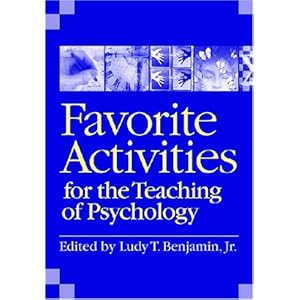
3) Teaching psychology activity books. These were compiled by Ludy Benjmin et al. and have a wide variety of activities for intro psych courses. Some are hits and some are misses (in my opinion) so you might want to buy one and see what you think. Here are several to try.

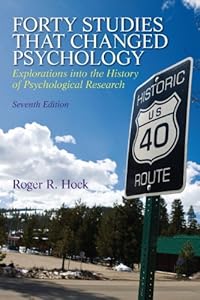
4) Forty Studies that Changed Psychology. An excellent overview that will be invaluable to you if you're just getting started, and is often used by many AP Psych teachers during the year or as a summer  assignment.

5) The publisher of your textbook. Find out what book you'll be using, then contact the publisher and get in touch with the high school representative for psychology. They are usually very helpful and can give you an idea of what might be available for you for free. A great tip from Michael Donner on the AP Psych list is to contact a publisher of another psychology textbook and see if you can get an exam copy of that book (or even find a used copy online). A second book can be very helpful for helping you come up with alternate examples or explanations for your students.

6) The National Council for the Social Studies Psychology Community. This group is part of NCSS and helps psychology teachers in many ways, including annual presentations at the NCSS conference, newsletters and more. You can e-mail chair Daria Schaffeld at daria.schaffeld AT d214.org to get a copy of the latest newsletter and to find out more. Also, consider attending the annual NCSS Conference to hear great presentations.

7) Your fellow teachers! If you know others in your district or region who teach psych, contact them and ask for help. Most psychology teachers are still the only ones in their school, so getting in touch with folks who are nearby and are willing to share can be immensely helpful. Or join an e-mail list for psychology teachers such as Psych-News, TIPS or PsychTeacher (see a full list here) and make connections all over the world!

8) A final rec and plug: this Teaching High School Psychology blog which is run by Kent Korek, Chuck Schallhorn, Rob McEntarffer, Nancy Diehl, Kristin Whitlock, Trevor Tusow and myself. It's a site for us to share with our fellow teachers the things that we like, find interesting, have questions about, etc. Follow us via e-mail so you are notified every time we post something new, in your RSS reader or just bookmark us and visit when you can. You can also follow me (Steve) on Twitter at @highschoolpsych.


One final bit of advice: Psychology is a science. It doesn't matter what your background is as long as you're willing to embrace the scientific perspective and run with it. Have fun and enjoy teaching psychology!

--posted by Steve

Thursday, August 29, 2013

UTOPSS Fall Conference: September 13, 2013


The 15th annual Utah-Teachers of Psychology in Secondary Schools (UTOPSS) Fall Conference will be held Friday, September 13, 2013 at Westminster College in Salt Lake City, Utah.  The goal of the Conference is to improve the teaching of scientific psychology at the high school level.  High school teachers receive activities that they can implement in their classrooms, resources, and the opportunity to network with others.  Presentations by university faculty give teachers insight on topics that may not always be covered in their textbooks. We have a fabulous day planned! 

Dr. Elizabeth Yost-Hammer (Xavier University of Louisiana):  I think (about thinking), therefore I am: Fostering metacognition in Introductory Psychology

Dr. Elliott Hammer (Xavier University of Louisiana): Beating the lag: What we have learned since your textbook was published

Dr. Lesa Ellis (Westminster College, UT):  Adolescent Brain Development: New Explanations for Old Observations

Lisa Jensen (Herriman High School, UT) and Lisa Olsen (Davis High School, UT):  My “go to” activities!

David Rockwood (Payson High School, UT):  Teaching Sports Psychology

Dr. Elizabeth Yost-Hammer (Xavier University of Louisiana) and Kristin Whitlock (Viewmont High School, UT) What’s New in AP Psychology?

Participant Idea Share

Registration is due Friday, September 6.  Please contact me if you would like to receive registration materials (kwhitlock@dsdmail.net).

I hope you can join us!
Kristin H. Whitlock

Information about the DSM-5 and AP Psych

Breaking news! (See the image below for the news)


--posted by Steve

Wednesday, August 28, 2013

Research Opportunity- Replication!


If any of you are planning on getting your students involved with research experiences, than this announcement might be useful: The Society for the Teaching of Psychology (great organization, by the way, and they love high school teacher members!) recently started an effort to encourage psychology students to replicate recent and important psych studies:

Open Science Framework - Collaborative Replications and Education Project

This "call" is pointed at college students and teachers, but I don't think there's any reason why ambitious high school folks shouldn't be involved! The list of studies that they are encouraging replication for is intriguing (list below). If any of you high school folks dive into this, please let us know so we can post about it on the blog?


  • Griskevicius, V., Tybur, J. M., & Van den Bergh, B. (2010). Going green to be seen: Status, reputation, and conspicuous conservation. Journal of Personality and Social Psychology, 98(3), 392-404. Study 1
  • Elliot, A. J., Niesta Kayser, D., Greitemeyer, T., Lichtenfeld, S., Gramzow, R. H., Maier, M. A., & Liu, H. (2010). Red, rank, and romance in women viewing men. Journal of Experimental Psychology. General, 139(3), 399. Study 7
  • Back, M. D., Stopfer, J. M., Vazire, S., Gaddis, S., Schmukle, S. C., Egloff, B., & Gosling, S. D. (2010). Facebook profiles reflect actual personality, not self-idealization. Psychological Science, 21(3), 372-374. Study 1
  • Diener, E., Ng, W., Harter, J., & Arora, R. (2010). Wealth and happiness across the world: material prosperity predicts life evaluation, whereas psychosocial prosperity predicts positive feeling. Journal of Personality and Social Psychology, 99(1), 52. Study 1
  • Mazar, N., & Zhong, C. B. (2010). Do green products make us better people?.Psychological Science, 21(4), 494-498. Study 2
  • Weinstein, N., & Ryan, R. M. (2010). When helping helps: autonomous motivation for prosocial behavior and its influence on well-being for the helper and recipient. Journal of Personality and Social Psychology, 98(2), 222. Study 4
  • Kool, W., McGuire, J. T., Rosen, Z. B., & Botvinick, M. M. (2010). Decision making and the avoidance of cognitive demand. . Journal of Experimental Psychology. General, 139(4), 665. Study 1
  • Tsouloupas, C. N., Carson, R. L., Matthews, R., Grawitch, M. J., & Barber, L. K. (2010). Exploring the association between teachers’ perceived student misbehaviour and emotional exhaustion: the importance of teacher efficacy beliefs and emotion regulation. Educational Psychology, 30(2), 173-189. Study 1
  • Kiefer, M., & Martens, U. (2010). Attentional sensitization of unconscious cognition: task sets modulate subsequent masked semantic priming. Journal of Experimental Psychology. General, 139(3), 464. Study 1
  • Florian Jaeger, T. (2010). Redundancy and reduction: Speakers manage syntactic information density. Cognitive Psychology, 61(1), 23-62. Study 1
posted by Rob McEntarffer

Tuesday, August 27, 2013

You Can't Always Get What You Want. . .

But if you try sometimes, you get what you need.  Or so say the Rolling Stones. Some of you know of my weird situation of having the AP Psych course taken from me after having taught it for 20 years.  I did not react well.  I took it personally.  My ego was bruised.  I was angry and felt betrayed.

After a summer of job searching, much ego soothing, moving to a new home, and filming a new AP Psych course, I still find myself not teaching AP Psych for my local high school.  That decision without any real explanation was infuriating, exasperating, sickening, irrational, absurd, and more.  It took me some time to process everything.  I am good enough for the world (During the summer, I filmed an AP Psych course for Educator.com coming out soon), but I am not good enough for the local high school).  Oh delicious irony.

So after way too much reflection and a decidedly negative attitude coming back into the school year, I realized what I needed--to work with kids.  Generally speaking, adults make me crazy since they are often not rational and have a lot of educational/personal baggage they bring to our various interactions.  The primary reason I got into teaching was the kids.  Kids are fantastic. The kids I have here at my school are fantastic.  Are they all going to college?  No.  Are they all going on to post-HS training of some sort?  No.  Do they need adults who can role model mature behavior and lifelong learning and have a positive and nurturing attitude?  Absolutely.  When I came to California, I realized that most anyone could have taught my students back in the Midwest and the kids would have been successful--they had families who supported them in visible and invisible ways.  Here, the kids need adults since they are often missing the support mechanisms of home, family, and too often, basic needs being met.

So what do I need?  To be working with kids in high school.  What do I want?  To be teaching kids through the subject of psychology (and by extension AP Psych).  Do I need the AP?  No.  Once I accepted that last part, my life became much more positive.  With only two preps, I am becoming a better teacher in both my US Gov and regular Psych classes.  I have time.  Time to advise, time to plan, time to grade, time to work out, time to read, time to relax.
.

So I choose to be positive by getting what I need.  I choose to create a more positive reality by controlling the things I can control--my attitude.

Be well everyone and may your school years be wonderful and amazing.

Chuck Schallhorn

Monday, August 26, 2013

New to High School Psych? Repost

Steve Jones originally posted this, but it bears repeating given the new teachers of psych joining our ranks every year.
=======================================================================

If you or someone you know will be teaching high school psychology for the first time and don't know where to begin, THIS is the place! Below is a list of steps (modified from a post I (Steve) made to the AP Psych e-mail list earlier this year) that you want to take NOW so that you are ready to come out swinging when your school year begins:

Welcome new psychology teacher! Congratulate yourself on finding/stumbling on/being forced to teach the best class in high school!

There is an abundance of materials out there so you don't have to reinvent the wheel your first year (although you should feel free to after that). Here are some of the best resources to start with:


1) TOPSS which stands for Teachers of Psychology in Secondary Schools and is part of the American Psychological Association. Join TOPSS and you become an affiliate member of the APA at a fraction of the cost that other professionals pay, only $40 per year. TOPSS has lesson plans for every unit of the high school psych course and is in the process of revising older units so that the lesson plans remain vital and useful. They're created by high school teachers and are edited by psych professors. There's also a quarterly newsletter, the Psychology Teachers Network, and an annual conference for high school teachers at Clark University. Finally, and maybe most importantly, the APA and TOPSS have created the National Standards for High School Psychology. The first version of standards was created in 2005 and the newest version of the standards are being revised and should be out soon. (Full disclosure: I'm currently a member-at-large for the TOPSS Board.)
2) The College Board. Even if you don't teach AP Psychology this is a great resource -- and if you do, it's terrific! Here are some pages to start with.
a) The AP Psych home page
b) The course description (aka the Acorn Book, in PDF)
c) The AP Psych teachers guide -- written by Kristin Whitlock, this thing is a beauty and a GREAT place to get started if you're new to the course (also in PDF)
d) Old AP Psych exam questions
e) AP Psych store - you'll want to buy the 2004 and 2007 released exam multiple choice questions at some point

3) Teaching psychology activity books. These were compiled by Ludy Benjmin et al. and have a wide variety of activities for intro psych courses. Some are hits and some are misses (in my opinion) so you might want to buy one and see what you think. Here are several to try.
4) Forty Studies that Changed Psychology. An excellent overview that will be invaluable to you if you're just getting started, and is often used by many AP Psych teachers during the year or as a summer  assignment.

5) The publisher of your textbook. Find out what book you'll be using, then contact the publisher and get in touch with the high school representative for psychology. They are usually very helpful and can give you an idea of what might be available for you for free. A great tip from Michael Donner on the AP Psych list is to contact a publisher of another psychology textbook and see if you can get an exam copy of that book (or even find a used copy online). A second book can be very helpful for helping you come up with alternate examples or explanations for your students.

6) The National Council for the Social Studies Psychology Community. This group is part of NCSS and helps psychology teachers in many ways, including annual presentations at the NCSS conference, newsletters and more. You can e-mail chair Daria Schaffeld at daria.schaffeld AT d214.org to get a copy of the latest newsletter.

7) Your fellow teachers! If you know others in your district or region who teach psych, contact them and ask for help. Most psychology teachers are still the only ones in their school, so getting in touch with folks who are nearby and are willing to share can be immensely helpful. Or join an e-mail list for psychology teachers such as Psych-News, TIPS or PsychTeacher (see a full list here) and make connections all over the world!

8) A final rec and plug: this Teaching High School Psychology blog which is run by Kent Korek, Chuck Schallhorn, Rob McEntarffer, Trevor Tusow and myself. It's a site for us to just share with our fellow teachers the things that we like, find interesting, have questions about, etc. Follow us via e-mail so you are notified every time we post something new, in your RSS reader or just bookmark us and visit when you can. You can also follow me (Steve) on Twitter at @highschoolpsych.


One final bit of advice: Psychology is a science. It doesn't matter what your background is as long as you're willing to embrace the scientific perspective and run with it. Have fun and enjoy teaching psychology!

  --posted by Steve