Wednesday, March 31, 2010

Teaching Tolerance

You've certainly seen their free magazines and perhaps even their emails.  The Southern Poverty Law Center's education project is an outstanding site dealing with a variety of prejudice and reduction of prejudice articles, activities, and resources.  One could literally teach an entire course utilizing the materials on this site.
The Magazine
Professional Development
Activities Search Page with list below
Mix It Up

If you are a believer in social justice, reducing prejudice, increasing understanding, and increasing an understanding of history, this is a fantastic site.
Enjoy,

Chuck

Tuesday, March 30, 2010

Optics for Teens

Going back through my bookmarks, I (Chuck) ran across this site, Optics for Teens.  The site is very basic, but includes great information:

What is optics?
Celebrities and experts in the fields of light
Optical Illusions
Additional links to light and vision 
Gallery Page
Page for Teachers and Parents
The image below is in the site's gallery as an example of the sun seen in three ultraviolet lights

Monday, March 29, 2010

Junk Food and Addictions

I am not a small man.  BTW, this is Chuck.  You could call me large, big, fluffy (ode to Gabriel Iglesias), husky, bouncer-like, and more.  I am 6'3" 310 pounds.  Large, but proportional. 

I've always had a sweet tooth--I love the junk food and sugar in nearly all its incarnations.  This morning, I saw an article on NPR called, "Junk Food Jones Is Wired in Your Brain."  This confirmed what I suspected--I am an addict.  It was shown in a fascinating bit of research which could even diverge into a discussion of ethics and animal research.
One quote:  "Inside their little brains, the junk-food eating rats developed a big problem. Just like drug takers, the rats needed a bigger fix of junk food over time to maintain their pleasure. So they kept on eating, and kept on getting fatter. As the scientists explained in their paper, "extended access to palatable high-fat food can induce addiction-like deficits in brain reward function," which can spur overeating and lead to obesity."

If nothing else, this offers some good insight into the workings of the addicted brain and one factor in the obesity epidemic in the US.

The Illusion Sciences Blog

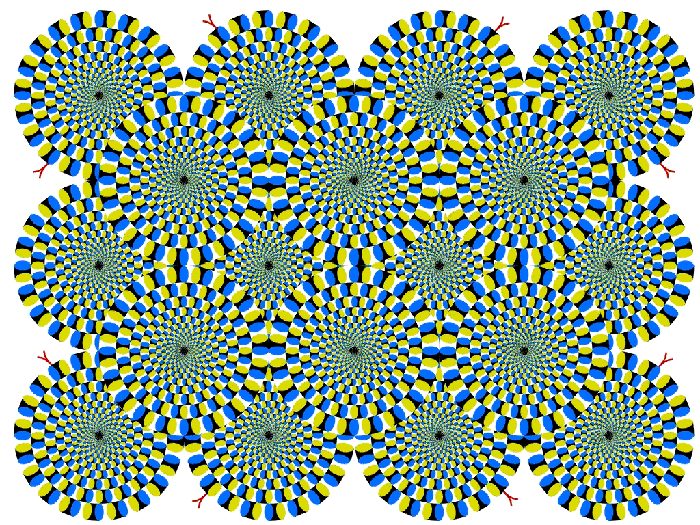
When I (this is Chuck) began teaching AP Psych, I had difficulty explaining why certain illusions were based in the eye and why others were based in the brain.  I had never had an undergraduate course in sensation and perception and my book resources were almost non-existent.  There is a proliferation of illusion sites on the web, but few actually explain the illusion. I've discovered the Illusion Sciences blog site that explains the illusions much to my delight.

Saturday, March 27, 2010

Gaming and Making a Better World

I was doing some research on intelligence and, of course, went to the TED web site.   While researching, I came across a fascinating talk (no surprises there) about gaming as a tool to improve the world.

This idea intrigued me so I began watching a game designer, Jane McGonigal talk about the qualities that gamers possess and how they could possibly turn their enthusiasm, focus, and optimism form the virtual world and somehow translate that into the real world.  Fascinating--worth the 15 minutes.

For the record, I am not a gamer, but many of my students are and were also intrigued by her ideas.  Additionally, one could argue that it takes a great deal of psychological knowledge to make a satisfying gaming experience.  In fact, one could use the video as a point of analysis for psychological concepts (that are mentioned, but not by name).  Again, great stuff.

Friday, March 26, 2010

AP Text--Coon and Mitterer

The textbook recommendation below comes with some background.  I have taught Psychology since 1987 and A.P. Psychology since 1992 (second year of course).  During that time, I have used a variety of texts, including Exploring Psychology, Psychology and You, Exploring Psychology, multiple editions of the Myers Psychology text, Ludy Benjamin's intro text from the mid-90s and the second edition of the Wade and Tavris text.  I currently use the Dennis Coon text Psychology: A Journey as my regular psychology text and his college text for my current AP course.

A few weeks ago, I asked the readers of this blog for info on their favorite textbooks, but neglected to share my own views about my favorite and current AP Psychology text, Introduction to Psychology: Gateways to Mind and Behavior by Coon and Mitterer, 11th Edition.  The publisher is Thomson/Wadsworth.  The book has 700 pages including an appendix on statistics.

While there are a few concepts that the book omits, it has really cut down on my handouts--so many things that I used to use as supplements, I now have within the text itself--it's almost as though the authors got inside my head and asked me what I wanted within the text.  The arrangement of and coverage of the content is pretty similar to most texts with the text finishing with a chapter on applied psychology.

The level of the text is at a semi-difficult level for my students.  My kids range from the college-bound top-ten student to the community college student without the grades to get into a four-year university.  Some use it with ease, and others have to work pretty hard to understand it-I have a large range of abilities.

The teacher's ancillaries are weak compared to Myers, but everything is on a few CDs and I can edit at will on the handouts, objectives, vocabulary, etc.  The test bank has 200-700 multiple choice questions per chapter, which allows me many options-the test generator is ExamView, which I've grown quite fond of over the years. 

I would recommend the text as a reference text for a new teacher, but with the lack of extras, such as the "Bold Manual" that comes with the Myers books, I would say that this is a book for veterans rather than newbies to teaching AP Psych.  That said though, I really, really like the book.

Mental Health Medications

The National Institute of Mental Health (NIMH) at http://www.nimh.nih.gov has published an excellent 30 page booklet entitled Mental Health Medications. The booklet, organized by disorders, details many of the psychiatric medications used today. The publication ends with an alphabetical listing of drugs.

The booklet can be viewed online at http://www.nimh.nih.gov/health/publications/mental-health-medications/index.shtml and/or downloaded as a PDF file at http://www.nimh.nih.gov/health/publications/mental-health-medications/nimh-mental-health-medications.pdf

Thursday, March 25, 2010

Inversion Goggles from PsychKits.com

In the last few months, Gerry Palmer introduced a new product to the line of PsychKit.com games and activities; a set of inversion goggles. These glasses literally "turn the world upside down" for the viewer, use only one 4" prism. This design makes for a larger field of vision than the older two prism models.

Students can have fun trying to write their name, pick up an object or draw a picture using the goggles. The inversion goggles work perfectly when covering how the lens in the eye inverts the image.

A student in the AP Psychology class at Pinkerton Academy of Derry, NH has posted a short (1:38) YouTube video of someone wearing a set of inversion goggles trying fairly unsuccessfully to write her name on a white board at http://www.youtube.com/watch?v=lpKEHEuJ2oQ It should be noted, the goggles in the video are not from PsychKits, but instead made by Jim Matiya who for many many years was the main supplier of both displacement and inversion goggles for teachers around the country.

For more information on the inversion goggles go to http://www.psychkits.com/inversion_goggles.html

For the PsychKits.com homepage go to http://www.psychkits.com Be sure to check out the displacement goggles as well.
Once again we are back to the 2000 version of Abnormal Psychology and Modern Life (11e) by Robert Carson, James Butcher, and Susan Mineka from Allyn and Bacon. On March 17th we posted information (http://teachinghighschoolpsychology.blogspot.com/2010/03/abnormal-case-studies.html)regarding three cases studies on the book's website.

Today we are writing about an activity found in the Teacher's Toolbox section regarding therapy. After students read through four short paragraphs describing the actions of a therapist, they must determine which type of technique (school) they use.

Please feel free to add examples in the comments section below. The therapy activity can be found at http://www.abacon.com/psychsite/tool_therapy.html

Wednesday, March 24, 2010

Carl Rogers Website

The Saybrook Graduate School and Research Center has developed a website devoted to the work of Carl Rogers. Below is the "About Us" page from the site.

The Carl Rogers website serves as a gateway to the work of Dr. Carl Rogers and the many disciplines he influenced. Its primary audience is scholars and practitioners. It is a project of Saybrook Graduate School and Research Center, funded by the proceeds of the 2002 Carl R. Rogers Centennial Symposium.

The site includes a bibliography of books and articles by and about Rogers and the Person-Centered Approach (PCA) with links to those that are available online. It makes available a collection of rich media - selected audio and video archives that are streamed as WindowsMedia, as well as samples from the CD ROM Carl Rogers: A Daughter's Tribute and Howard Kirschenbaum's videotape Carl Rogers and the Person-Centered Approach. The audio collection is selected from the Carl R. Rogers archive at University of California at Santa Barbara. A comprehensive list of (and links to) world-wide organizations and training centers connected with Rogers and the Person-Centered Approach is included.

The Carl Rogers website is located at http://www.carlrogers.info/index.html