Showing posts with label IQ. Show all posts

Tuesday, January 12, 2016

Ethically Teaching Psychological Assessment

A while back I posted a blog post about a website that I came across that would be great for our personality units - a website of really cool, original TAT images. I was pumped, but received a message regarding the post from someone much-less-enthusiastic about the post as I was. (I have since deleted the post due the concerns raised.) 


Dr. Ian MacFarlane of Austin College agreed to help educate me (and you, I hope) on why using original TAT, Rorschach or questions from actual IQ tests can be a real ethical dilemma. He also offers some great suggestion on what we CAN do. Here's what he had to say:


Ethically Teaching Psychological Assessment


With so much information at our fingertips, we can easily get primary source material to enrich our classrooms. Showing students pictures of the actual shock machine from Milgram’s study or grainy footage of Watson with Little Albert helps bring concepts to life in a way lecturing cannot. There is one area of psychology, however, where we must practice restraint and actually avoid exposing students to original material: psychological assessment. There are numerous places online where you can find the entire set of Rorschach and Thematic Apperception Test (TAT) cards or sample items from intelligence tests. Our natural instinct is to use this source material in our classrooms, but the problem is psychologists still actively use these assessments in clinical practice. Exposing our students to these stimuli in non-clinical settings can change their responses to these tests if they encounter them later. Thus we need to convey how the assessments work without showing students the exact stimuli used. I offer you a simple method for doing so.


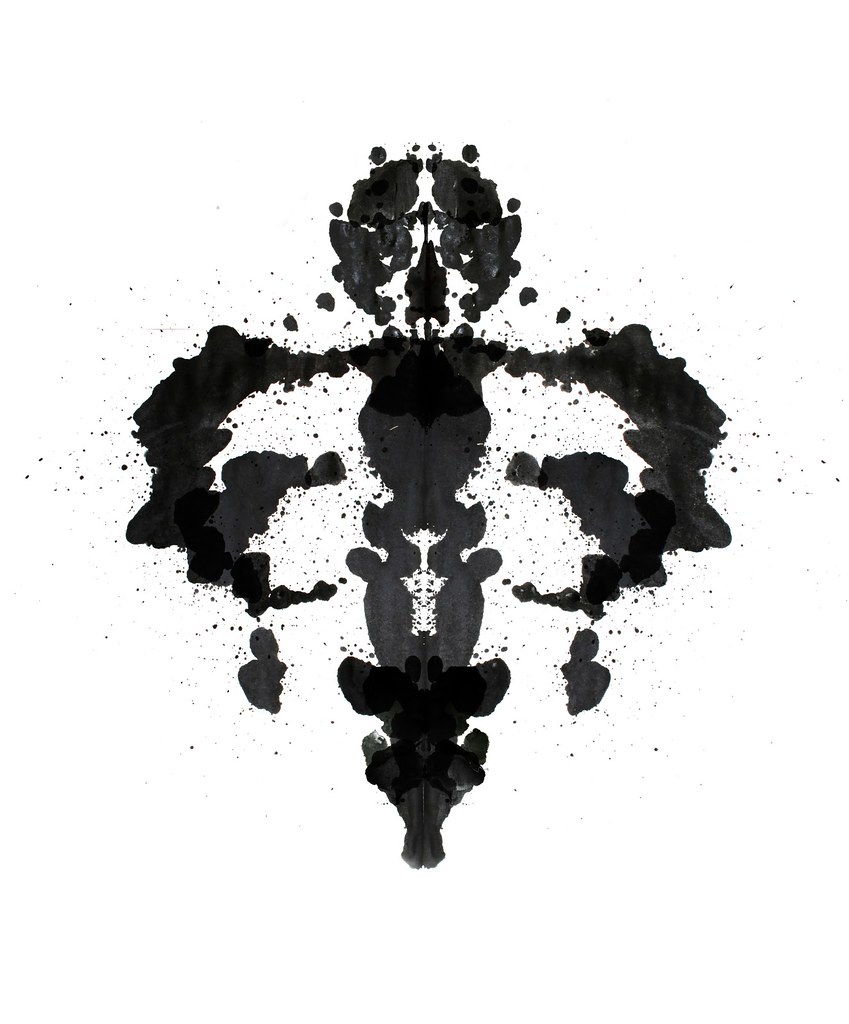
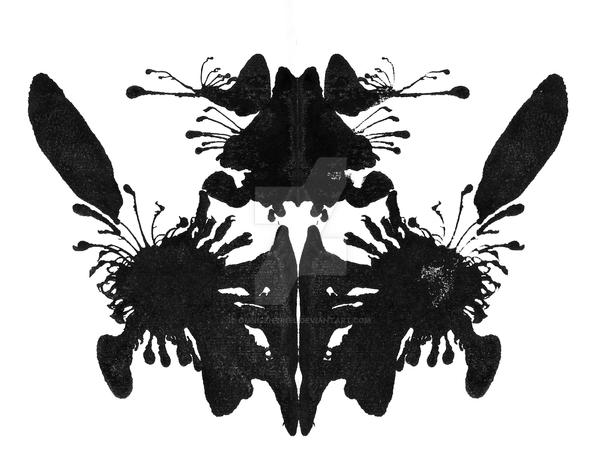
When I teach projective assessment, I usually cover the Rorschach and the TAT. For an in-class activity I take an image I find online to use as an example and have my students write a response as if they were actually being assessed. For Rorschach cards, search “inkblot images” in Google Image search or your favorite image search engine. Since I pass the images out to students for them to refer to later with their notes, I make sure to use an image licensed for reuse via Creative Commons (another search option in Google Image). Here’s an example from Flickr user BradleyLeese and another by DeviantArt user OmniSentinel. Be wary, as a lot of the actual cards are posted all over the web, but you can check the images you find against Wikipedia to be sure it’s not one of the originals. If you want to go a step further, you can have students actually make inkblots of their own. Margaret Peot has a page explaining how to do this as well as several examples. The instructions for the test are to explain what you see in the image.


For the TAT demo, I make sure to search only black-and-white images, and while the real TAT uses drawings exclusively, I don’t think that is essential to understanding the test so I also use photos if I like them. Here you can be creative with search terms, but I like to have multiple people interacting. Here’s an example of a photo I found when I searched for “conversation” (courtesy Flickr user Das Fotoimaginarium), and here’s an example of an engraving in the public domain from 1878 by Ridgway I found when I searched for “arguing.” Searching for images with these types of terms vastly reduces the likelihood that you’ll pull an actual stimulus from the TAT. The instructions for the test are to describe what led up to the moment you are witnessing, what are the characters thinking and feeling, and how does the situation resolve itself?


Explaining the objective assessments, like the MMPI, is typically more straightforward, but it is still important to not use actual items from the assessment. A demo I like to use when I introduce the empirical keying method of the MMPI starts by asking students to raise their hands if they enjoy going to concerts. I inform those who raised their hands they just received a point on the mania scale of the MMPI. While the other students snicker, I inform them they received a point on the hypochondriasis scale. I ask them to make sense of that, and eventually we get into the process used to develop the MMPI. I tell them afterwards that I made up the question, but it still illustrates the process nicely and gets them to think about psychometrics and the importance of norm groups.

Using these simple methods will allow you to confidently simulate the experience of taking a projective assessment while protecting the integrity of these tests so they can continue to be used in clinical settings.


Thanks to Dr. MacFarlane for educating me (Sorry, again!) and for the great suggestions. Ian MacFarlane, PhD (Follow him on Twitter at @I_MacFarlane) is an assistant professor of psychology at Austin College in Sherman, TX. He teaches general psychology, research methods, and several clinical psychology courses.

---- Posted by Amy Ramponi 

Tuesday, December 22, 2015

12 Days of Psychology Class: Day 2 - IQ Activity

Happy Holidays, everyone! Here is my 2nd "12 Days of Christmas...er...Psychology Class" post. We got a dusting of snow last night - but I'm waiting for the real thing and still holding out hope for a white Christmas.


At the NCSS New Orleans conference this past November, I attended a REALLY FABULOUS workshop session by Laura Brandt and David Elbaum of Stevenson High School in Lincolnshire, IL on incorportaing Law/Psychology. I was leafing through the "The Intersection of Law and Psychology" booklet that they shared with those who attended. In the packet, there was an article I read on the flight home entitled "Death by IQ: US Inmates Condemned by Flawless Tests" published by New Scientist.  As I was reading the article - I realized (basically) the WHOLE unit was in here! With very limited time (especially second semester) I need activities and articles that cover A LOT of ground.

Students were engaged, asking questions, and very interested in the topic when applied to the death penatly.

Sheet to accompany PPT slides

PPT slides 

Thanks to Laura and David for the great presentation and the great idea!


-- Posted by Amy Ramponi

Tuesday, November 17, 2009

History of IQ Testing

IQ Tests are primarily a product of the 20th Century . While most textbooks provide a brief history, starting with Binet, a few websites do the same.

The ACE Intelligence Website at http://www.aceintelligence.com/detailed_history_of_iq.php, gives a fairly detailed history of IQ testing following various individuals important in test development including a few prior to Binet.

The IQ Test Center at http://www.iqtest-center.com/history.php provides a brief history of testing similar to many textbooks.

Classics in the History of Psychology (http://psychclassics.yorku.ca/author.htm) have a number of the original articles on intelligence testing. They include:

Baldwin, James Mark, Cattell, James McKeen, & Jastrow, Joseph. (1898). Physical and mental tests. Psychological Review, 5, 172-179.

Binet, Alfred. (1916). New methods for the diagnosis of the intellectual level of subnormals. In E. S. Kite (Trans.), The development of intelligence in children. Vineland, NJ: Publications of the Training School at Vineland. (Originally published 1905 in L'Année Psychologique, 12, 191-244.)

Cattell, James McKeen. (1890). Mental tests and measurements. Mind, 15, 373-381.

Terman, Lewis M. (1916). The uses of intelligence tests. From The measurement of intelligence (chapter 1). Boston: Houghton Mifflin.

Monday, March 16, 2009

Mensa Test

On their website, Mensa International, a society for the top 2% of the world's IQs, includes a "workout page" with a 30 question IQ style test. While the test is for "entertainment purposes only", your students will probably find it extremely challenging.

To take the test, go to http://www.mensa.org/index0.php?page=12 For more information on Mensa, click the Mensa icon above.

Wednesday, March 11, 2009

Psych in the news

Seriously? There is so much news flying by I'll never catch up. Today's installment is in fast forward with a minimum amount of words, no credits and crammed in every which way.

Calculating very rare events * Do psychologists still use Rorschach tests? * The mental heath of Iraqis after years of war * How ads enhance TV watching * The flexibility of dream interpretation * Does stress cause gray hair? * Older dads linked to lower IQ kids * Single sex classes in public schools * Placebos in teen depression studies * Brain differences between the religious and non-religious (and hear the NPR report) * Psychology and neuroscience on Twitter *

Two longer ones to end on: shark attacks are dropping and the economy's to blame! (Does anyone else use the correlation does not equal causation example of shark attacks and ice cream sales? So now shark attacks and the economy are correlated?)


Finally, a WARNING: this article in the Washington Post magazine on children dying in cars accidentally because they were forgotten by their parents is difficult to read (or at least it was for me -- there are parts I just had to skim through). I add it only because of the questions it raises about memory, inattention, distraction and people being off of their routines which leads to forgetting. There's also a sidebar on ways to prevent these tragedies -- sure, there's some technology, but there are also the simple things like putting something that you need for work (ID badge, briefcase, keys, etc.) in the back with the child. Kids and Cars also has other devices.

Saturday, February 14, 2009

Psych in the news

Should scientists study race and IQ? No, society and science do not befit. Yes, the scientific truth must be pursued. (Nature)

The truth is, spotting a lie isn't as easy as it looks. (Washington Post)

Sensors help keep the elderly safe, and at home. (NY Times) [Slate calls is Lojack for people.]

Jonah Lehrer says diet soda's not our friend; the brain doesn't like to be tricked. (Science Blogs)

Toronto's holding the world's first (?) music concert accessible to the deaf and hard of hearing. (Boing Boing)

How your looks betray your personality. (New Scientist)