Wednesday, March 11, 2020
Iowa Teachers of Psychology Conference coming at you - April 17, 2020
Spring Conference Season is rolling around and Iowa has something great cooked up. Registration and more information on this great event is at their website located here:


Wednesday, May 15, 2019
Ohio Teachers - a great PD for you!

THE OHIO STATE OPTC 2019
The 2nd Ohio Psychology Teaching Conference (https://www.focusonpsych.org/
Throughout the course of the day, we will also have presentations from Dr. Ruchika Prakash (Ohio State University, neuroplasticity), Dr. Barbara Andersen (Ohio State University, biobehavioral aspects of cancer), Dr. Brad Bushman (Ohio State University, aggression and violence), Dr. Betsy Fox (Wright State University, sensation and perception), Dr. Vince Granito (Lorain Community College, Open Education Resources), and Dr. Melissa Beers (Ohio State University, the APA Intro Psych Initiative). Attendees will have the opportunity to take a tour through the Center for Cognitive and Behavioral Brain Imaging, as well as experience artifacts and engage in a talk on the history of psychology by the archivists from The University of Akron's The National Museum of Psychology. Participants will share quality lesson activities and discuss topical issues in the Teaching of Psychology. For information and registration, go to https://www.focusonpsych.or
--- Written by Stephanie Franks, Posted by Amy Ramponi
Tuesday, March 12, 2019
Iowa Teachers of Psychology Conference April 5, 2019
The Iowa Teachers of Psychology will be holding their annual teaching conference on April 5, 2019 at Hawkeye Community College in Waterloo. The legendary Sue Frantz will be their keynote speaker.
For more information, go to their website.

For more information, go to their website.

Monday, March 11, 2019
Professional Development Options for High School Psychology Teachers Part 2
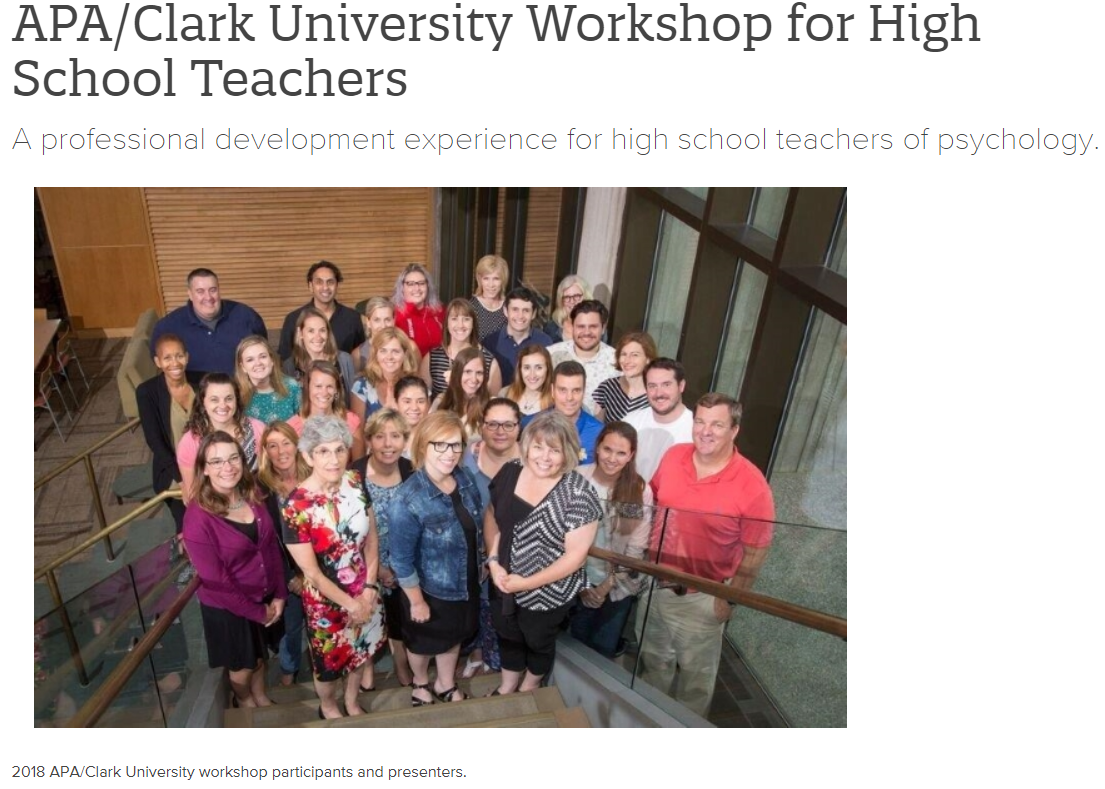
One of the best experiences for professional development is the APA/Clark Workshop. Ask any of the hundreds of "graduates" from the workshop and they will tell you it was one of the most professionally rewarding experiences they have had.
This year, Amy Ramponi and Brad Wray will be the primary Teachers of Psychology in Secondary Schools TOPSS presenters. Below is the photo from 2018.
I encourage anyone who is the sole psychology teacher in their school to apply. This is especially true if you are from a traditionally underrepresented community. One of the goals for the APA in general, and TOPSS more specifically is to bring in more people to increase ethnic, socioeconomic, gender, age, geographic, disability/ability, sexual orientation, and belief system diversity.

This year, Amy Ramponi and Brad Wray will be the primary Teachers of Psychology in Secondary Schools TOPSS presenters. Below is the photo from 2018.
I encourage anyone who is the sole psychology teacher in their school to apply. This is especially true if you are from a traditionally underrepresented community. One of the goals for the APA in general, and TOPSS more specifically is to bring in more people to increase ethnic, socioeconomic, gender, age, geographic, disability/ability, sexual orientation, and belief system diversity.
Professional Development Options for High School Psychology Teachers
The American Psychological Association (APA) and Teachers of Psychology in Secondary Schools (TOPSS) has some excellent professional development for teachers. Here are but a few:
The stars on the map represents the various regional and state conferences that are held regularly. Grants from the APA are available to apply for to underwrite the costs of the conference and/or speakers. Personally, I have been to both the Northern California, Arizona, Indiana, and Chicagoland conferences in my career. They have all been excellent and I came away with multiple activities and resources from all of them. Best of all, I gained friends and a professional learning network.

Thursday, September 20, 2018

Check out APA's Introductory Psychology Initiative (IPI)! Building on the momentum of recent events, such as the APA's Summit on High School Psychology Education, this group is taking an in-depth look into the Introductory Psychology course at all levels of education. The working groups are divided into 4 main areas: Student Learning Outcomes and Assessment, Teacher training, Course models and design, and Students success. Here's the future of Introductory Psychology!
http://www.apa.org/ed/precollege/undergrad/introductory-psychology-initiative/default.aspx
Kristin Whitlock
Wednesday, September 5, 2018
 JOIN US at UTOPSS!
UTAH-Teachers of Psychology in Secondary Schools Fall Conference
Westminster College, Salt Lake City UTAH
Friday, Sept 21 2018
7:30 am - 3:30 pm
PRESENTATIONS:
Dr. Rob McEntarffer, Lincoln Public Schools
What's Psych got to do with it? Using what we teach
Dr. Suzy Cox, Utah Valley University
The changing landscape of adolescence
Annette Nielsen, Woods Cross High School
Psychological Science: Adding Labs to Psychology
Dr. Jessica Habashi & Angela Anderson, Utah State University
Sensory System Demonstrations for Lab and Lecture
Participant Idea Share: Emily Checketts, Roy High School
Breakout sessions
• Sports Psychology: Jillian Carver, Sky View High School
• Introductory Psychology: Dr. Rob McEntarffer, Lincoln Public Schools
• AP Psychology: Erik Bayles, Pleasant Grove High School ; Tiffany Bliss, Olympus High School; Julie Gowans, Payson High School
Dr. Rob McEntarffer, Lincoln Public Schools
What's Psych got to do with it? Using what we teach
Dr. Suzy Cox, Utah Valley University
The changing landscape of adolescence
Annette Nielsen, Woods Cross High School
Psychological Science: Adding Labs to Psychology
Dr. Jessica Habashi & Angela Anderson, Utah State University
Sensory System Demonstrations for Lab and Lecture
Participant Idea Share: Emily Checketts, Roy High School
Breakout sessions
• Sports Psychology: Jillian Carver, Sky View High School
• Introductory Psychology: Dr. Rob McEntarffer, Lincoln Public Schools
• AP Psychology: Erik Bayles, Pleasant Grove High School ; Tiffany Bliss, Olympus High School; Julie Gowans, Payson High School
COST: $50 (due by Sept 14; after that date $60); includes continental breakfast, lunch, materials, certificate
REGISTER ONLINE at: https://www.westminstercollege.edu/about/academic-schools/undergraduate-schools/school-of-arts-and-sciences/psychology-department/utopss-conference
Hope to see you there!
Kristin Whitlock
Sunday, August 12, 2018
Teaching Psychology: Where Can I Find Help?
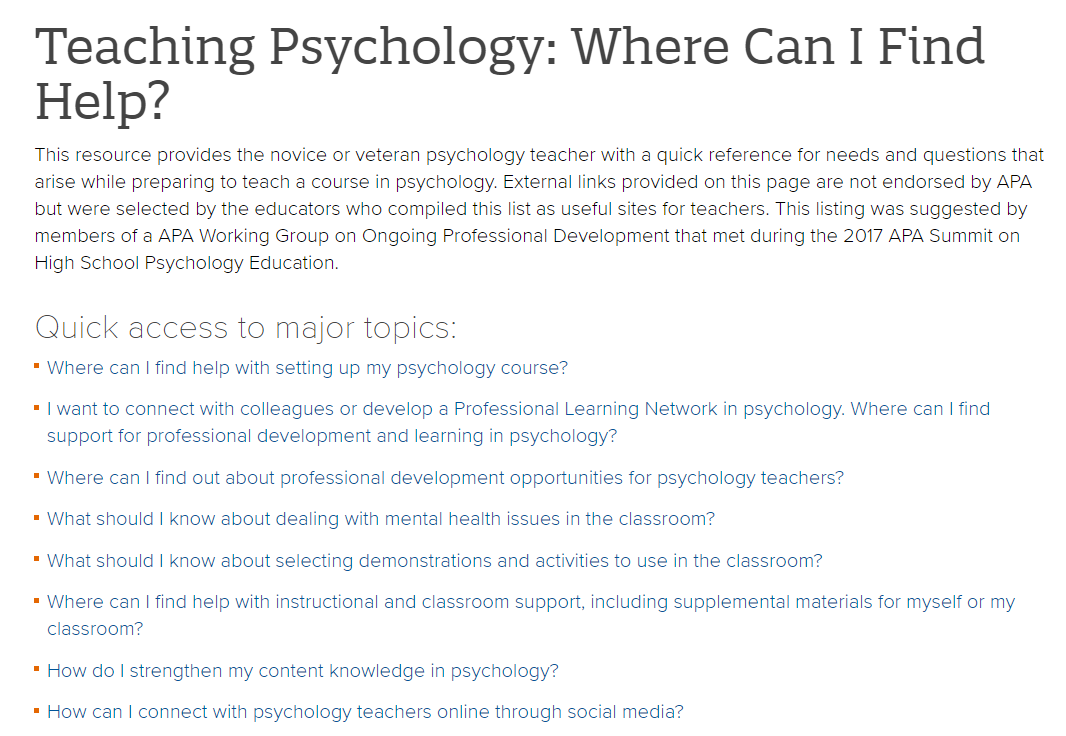
The great folks at the APA/TOPSS have created a wonderful list of online resources for psychology teachers called, "Teaching Psychology: Where Can I Find Help?" Highlights include information for regular psych, IB Psych, and AP Psychology; professional development; course development; PLNs; much more.
Check out the resources at the link above. Incredibly helpful for any teacher, not just teachers new to the profession or subject area.
posted by Chuck Schallhorn
Friday, August 10, 2018
New APA Resources--The Canvas Course

AMAZING NEW RESOURCE--Thank you to Brad Wray and the Tech Strand at the Psychology Summit!!!!
TOPSS High School Psychology Course Template available in Canvas – From the technology and online learning strand. A giant thanks to Brad Wray in particular for creating and filming the linked video on the site, and for all his work editing and uploading the course. Feel free to watch the video and download the course – feedback is welcome!
“This teaching resource for high school psychology teachers includes many content specific, peer-reviewed resources, videos and formative assessments organized by the National Standards for High School Psychology Curricula. The entire course template is shareable and customizable and can be used in on-line or in-person psychology classes.”
posted by Chuck Schallhorn
Tuesday, July 24, 2018
New to Teaching Psych? Some Key Resources--2018 Edition
Welcome new psychology teacher! Congratulate yourself on finding/stumbling on/being forced to teach the best class in high school! There is an abundance of materials out there so you don't have to reinvent the wheel your first year (although you should feel free to after that). Here are some of the best resources.
The following is a combination post with material from Chuck Schallhorn and Steve Jones.
1) TOPSS stands for Teachers of Psychology in Secondary Schools and is part of the American Psychological Association.
Join TOPSS and you become an affiliate member of the APA at a fraction of the cost that other professionals pay, only $50 per year. *NEW*
In 2011 teachers on the TOPSS board created a manual for new high school psychology teachers. This was written by high school psychology teachers who have "been there" with few resources and little help among your building colleagues.
Be sure to check this out! TOPSS has lesson plans for every unit of the high school psych course and is in the process of revising older units so that the lesson plans remain vital and useful. They're created by high school teachers and are edited by psych professors. There's also a quarterly newsletter, the Psychology Teachers Network, and an annual workshop for high school teachers at Clark University. Finally, and maybe most importantly, the APA and TOPSS have created the National Standards for High School Psychology.
The first version of standards was created in 2005 and the newest version of the standards was released in 2011. Following the Psychology Summit of 2017, a new steering committee has been tasked with creating new and updated standards in the upcoming years.
Full disclosure, Steve is a former chair of TOPSS and Chuck is currently a member-at-large.
2) The College Board
Even if you don't teach AP Psychology this is a great resource -- and if you do, it's terrific! Here are some pages to start with.:
3) Twitter
You will be amazed at all the valuable resources that are at your fingertips via Twitter. Many high school psychology teachers (like myself) consider my colleagues on Twitter to be an extremely valuable part of their personal learning community (PLN), and often share ideas and resources with each other.
In the past couple of years the hashtag #psychat has become a great way to share information as well. Other teachers are also using Twitter as a way to interact with their students online in many ways, such as commenting on news articles, sharing new sites and even homework reminders.
You can also follow Steve on Twitter at @highschoolpsych or Chuck at @MtnHousePsych.
4) Teaching psychology activity books.
These were compiled by Ludy Benjamin et. al. and have a wide variety of activities for intro psych courses. Some are hits and some are misses (in my opinion) so you might want to buy one and see what you think.
5) Forty Studies that Changed Psychology
An excellent overview that will be invaluable to you if you're just getting started, and is often used by many AP Psych teachers during the year or as a summer assignment.
6) The publisher of your textbook.
Find out what book you'll be using, then contact the publisher and get in touch with the high school representative for psychology. They are usually very helpful and can give you an idea of what might be available for you for free. A great tip from Michael Donner on the AP Psych list is to contact a publisher of another psychology textbook and see if you can get an exam copy of that book (or even find a used copy online). A second book can be very helpful for helping you come up with alternate examples or explanations for your students. Chuck has more than 15 alternate introductory texts--there are even activities one can do with multiple textbooks.
7) The National Council for the Social Studies Psychology Community.
This group is part of NCSS and helps psychology teachers in many ways, including annual presentations at the NCSS conference, newsletters and more. They are available on Twitter at https://twitter.com/NCSSPC
You can e-mail chair Daria Schaffeld at daria.schaffeld AT d214.org to get a copy of the latest newsletter and to find out more. Also, consider attending the annual NCSS Conference to hear great presentations.
8) Your fellow teachers!
Though there are still listservs (which I have purposely omitted), there is the facebook AP Psych teacher group. While there are some excellent resources shared, some of the ideas shared are not connected to standards or other reliable sources and lack pedagogical quality. The google drive there is filled with ideas, so if you have time and interest, do check it out.
9) A Blog Plug: this Teaching High School Psychology blog
The blog was created by Steve Jones, Kent Lorek, and Chuck Schallhorn with Chuck being the primary contributor at the moment. Other contributors include Rob McEntarffer, Nancy Diehl, and Kristin Whitlock. It's a site for us to share with our fellow teachers the things that we like, find interesting, have questions about, etc. Follow us via e-mail so you are notified every time we post something new, in your RSS reader or just bookmark us and visit when you can.
When planning a new unit, check out the blog at http://teachinghighschoolpsychology.blogspot.com/ and do a unit search for videos and assignments that we have. You can do this by checking out the list of units in the left-hand column of the blog.
There are hundreds of ideas and resources we have posted throughout the years. One final bit of advice: Psychology is a science. It doesn't matter what your background is as long as you're willing to embrace the scientific perspective and run with it. Have fun and enjoy teaching psychology!
We have a THSP Psychology folder on Google docs that has many resources for each unit. These activities have been vetted and are appropriate and quality lessons
https://drive.google.com/open?id=0B28t_LsPkwHefnRSTU5aWVFQVHo3MVBSZEEzTHczTXpPT09EMzVOLXhsdVBVRmdNTmRNUms
**test out this link and make sure you can get inside each folder. Contact Chuck if there are any issues with the link.
10) Brain Games
The video series from National Geographic is outstanding for psychology and neuroscience demonstrations. In fact, it has overtaken many of our in-class demos both in terms of quality and quantity. You can purchase the DVDs online at Amazon.com or stream a couple seasons on Netflix. For content guides for all five seasons, click here.
11) Chuck Schallhorn has a YouTube Channel
This can help out with some of the more complex ideas for the students at: https://www.youtube.com/channel/UCOG05VwbujNwGUX5UA0zcXQ
12) Chuck and Educator.com
https://www.educator.com/psychology/ap-psychology/schallhorn/
It costs money, but if you are desperate, this should help out. You can also search YouTube for teachers who have put their lessons online. They are of varying quality
13) APA Division 2-The Society for the Teaching of Psychology
They have an amazing set of resources on their OTRP website.
14) Joe Swope (longtime psych teacher who is currently on the TOPSS board) has an amazing site you can sign up for at http://swopepsych.com/. There are many quality resources here including his videos on psychology.
17) Crash Course Psychology videos
The main playlist is available here--great for quick reviews, overviews, background information, or even as student homework--they are densely packed with information.
If there are any resources we missed, please leave them in the comments. posted by Chuck Schallhorn in 2018.
posted by Chuck Schallhorn
The following is a combination post with material from Chuck Schallhorn and Steve Jones.
1) TOPSS stands for Teachers of Psychology in Secondary Schools and is part of the American Psychological Association.
Join TOPSS and you become an affiliate member of the APA at a fraction of the cost that other professionals pay, only $50 per year. *NEW*
In 2011 teachers on the TOPSS board created a manual for new high school psychology teachers. This was written by high school psychology teachers who have "been there" with few resources and little help among your building colleagues.
Be sure to check this out! TOPSS has lesson plans for every unit of the high school psych course and is in the process of revising older units so that the lesson plans remain vital and useful. They're created by high school teachers and are edited by psych professors. There's also a quarterly newsletter, the Psychology Teachers Network, and an annual workshop for high school teachers at Clark University. Finally, and maybe most importantly, the APA and TOPSS have created the National Standards for High School Psychology.
The first version of standards was created in 2005 and the newest version of the standards was released in 2011. Following the Psychology Summit of 2017, a new steering committee has been tasked with creating new and updated standards in the upcoming years.
Full disclosure, Steve is a former chair of TOPSS and Chuck is currently a member-at-large.
2) The College Board
Even if you don't teach AP Psychology this is a great resource -- and if you do, it's terrific! Here are some pages to start with.:
- The AP Psych home page
- The course description (aka the Acorn Book, in PDF; updated Fall 2014)
- The AP Psych teachers guide -- written by THSP's own Kristin Whitlock, this thing is a beauty and a GREAT place to get started if you're new to the course (also in PDF)
- College Board Psych Activities/Resources
- Old AP Psych exam FRQ questions
- AP Psych store - you may want to buy the 2004 and 2007 released exam multiple choice questions at some point--there are released exams available through the Audit Page you will need to authorize your course
- *NEW* If you are an AP Psych teacher, be sure to join the online AP Psychology Community.
3) Twitter
You will be amazed at all the valuable resources that are at your fingertips via Twitter. Many high school psychology teachers (like myself) consider my colleagues on Twitter to be an extremely valuable part of their personal learning community (PLN), and often share ideas and resources with each other.
In the past couple of years the hashtag #psychat has become a great way to share information as well. Other teachers are also using Twitter as a way to interact with their students online in many ways, such as commenting on news articles, sharing new sites and even homework reminders.
You can also follow Steve on Twitter at @highschoolpsych or Chuck at @MtnHousePsych.
4) Teaching psychology activity books.
These were compiled by Ludy Benjamin et. al. and have a wide variety of activities for intro psych courses. Some are hits and some are misses (in my opinion) so you might want to buy one and see what you think.
5) Forty Studies that Changed Psychology
An excellent overview that will be invaluable to you if you're just getting started, and is often used by many AP Psych teachers during the year or as a summer assignment.
6) The publisher of your textbook.
Find out what book you'll be using, then contact the publisher and get in touch with the high school representative for psychology. They are usually very helpful and can give you an idea of what might be available for you for free. A great tip from Michael Donner on the AP Psych list is to contact a publisher of another psychology textbook and see if you can get an exam copy of that book (or even find a used copy online). A second book can be very helpful for helping you come up with alternate examples or explanations for your students. Chuck has more than 15 alternate introductory texts--there are even activities one can do with multiple textbooks.
7) The National Council for the Social Studies Psychology Community.
This group is part of NCSS and helps psychology teachers in many ways, including annual presentations at the NCSS conference, newsletters and more. They are available on Twitter at https://twitter.com/NCSSPC
You can e-mail chair Daria Schaffeld at daria.schaffeld AT d214.org to get a copy of the latest newsletter and to find out more. Also, consider attending the annual NCSS Conference to hear great presentations.
8) Your fellow teachers!
Though there are still listservs (which I have purposely omitted), there is the facebook AP Psych teacher group. While there are some excellent resources shared, some of the ideas shared are not connected to standards or other reliable sources and lack pedagogical quality. The google drive there is filled with ideas, so if you have time and interest, do check it out.
9) A Blog Plug: this Teaching High School Psychology blog
The blog was created by Steve Jones, Kent Lorek, and Chuck Schallhorn with Chuck being the primary contributor at the moment. Other contributors include Rob McEntarffer, Nancy Diehl, and Kristin Whitlock. It's a site for us to share with our fellow teachers the things that we like, find interesting, have questions about, etc. Follow us via e-mail so you are notified every time we post something new, in your RSS reader or just bookmark us and visit when you can.
When planning a new unit, check out the blog at http://teachinghighschoolpsychology.blogspot.com/ and do a unit search for videos and assignments that we have. You can do this by checking out the list of units in the left-hand column of the blog.
There are hundreds of ideas and resources we have posted throughout the years. One final bit of advice: Psychology is a science. It doesn't matter what your background is as long as you're willing to embrace the scientific perspective and run with it. Have fun and enjoy teaching psychology!
We have a THSP Psychology folder on Google docs that has many resources for each unit. These activities have been vetted and are appropriate and quality lessons
https://drive.google.com/open?id=0B28t_LsPkwHefnRSTU5aWVFQVHo3MVBSZEEzTHczTXpPT09EMzVOLXhsdVBVRmdNTmRNUms
**test out this link and make sure you can get inside each folder. Contact Chuck if there are any issues with the link.
10) Brain Games
The video series from National Geographic is outstanding for psychology and neuroscience demonstrations. In fact, it has overtaken many of our in-class demos both in terms of quality and quantity. You can purchase the DVDs online at Amazon.com or stream a couple seasons on Netflix. For content guides for all five seasons, click here.
11) Chuck Schallhorn has a YouTube Channel
This can help out with some of the more complex ideas for the students at: https://www.youtube.com/channel/UCOG05VwbujNwGUX5UA0zcXQ
12) Chuck and Educator.com
https://www.educator.com/psychology/ap-psychology/schallhorn/
It costs money, but if you are desperate, this should help out. You can also search YouTube for teachers who have put their lessons online. They are of varying quality
13) APA Division 2-The Society for the Teaching of Psychology
They have an amazing set of resources on their OTRP website.
14) Joe Swope (longtime psych teacher who is currently on the TOPSS board) has an amazing site you can sign up for at http://swopepsych.com/. There are many quality resources here including his videos on psychology.
17) Crash Course Psychology videos
The main playlist is available here--great for quick reviews, overviews, background information, or even as student homework--they are densely packed with information.
If there are any resources we missed, please leave them in the comments. posted by Chuck Schallhorn in 2018.
posted by Chuck Schallhorn
Subscribe to:
Posts (Atom)


 Posts
Posts


