Showing posts with label 09 Developmental Psychology. Show all posts

Saturday, May 7, 2016

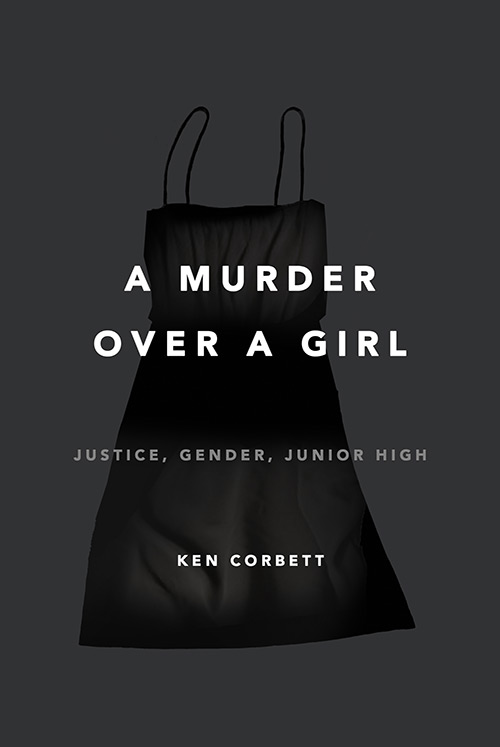
A Murder Over a Girl: Justice, Gender, Junior High

A Murder Over a Girl is a new book by Ken Corbett, a gender studies expert and NYU professor who went to Southern California to learn why a 15-year-old transgender student Larry 'Letitia' King was murdered. Corbett takes the reader through painstaking detail through the trial with its various witnesses, describing each with both a flair for observation, and inferences about the context, motivation, and meaning of the words they used. The book is not just about the murder or even the trial, but about how context matters for everything and how we shape the context in our own lives can lead us down very different paths. This book is fascinating, trouble, and insightful.

Cover Art
Corbett analyzes race, identity, poverty, culture, gun violence, and adolescence in a way I have never read before. Some parts of the book were hard for me to read due to the abhorrent nature of the ideology examined. That said, I believe this is a necessary book for all psychology and sociology teachers to help us understand the role that culture plays in our personal and collective lives. After so many years of teaching experience, I learned to look at education and my students through a new lens after reading this book.


From the Amazon description:
A psychologist's gripping, troubling, and moving exploration of the brutal murder of a possibly transgender middle school student by an eighth grade classmate On Feb. 12, 2008, at E. O. Green Junior High in Oxnard, CA, 14-year-old Brandon McInerney shot and killed his classmate, Larry King, who had recently begun to call himself "Leticia" and wear makeup and jewelry to school. Profoundly shaken by the news, and unsettled by media coverage that sidestepped the issues of gender identity and of race integral to the case, psychologist Ken Corbett traveled to LA to attend the trial. As visions of victim and perpetrator were woven and unwoven in the theater of the courtroom, a haunting picture emerged not only of the two young teenagers, but also of spectators altered by an atrocity and of a community that had unwittingly gestated a murder. Drawing on firsthand observations, extensive interviews and research, as well as on his decades of academic work on gender and sexuality, Corbett holds each murky facet of this case up to the light, exploring the fault lines of memory and the lacunae of uncertainty behind facts. Deeply compassionate, and brimming with wit and acute insight, A Murder Over a Girl is a riveting and stranger-than-fiction drama of the human psyche.

From the Publisher:
On February 12, 2008 in Oxnard, CA, 14-year-old Brandon McInerney and the rest of his eighth grade class walked to the computer lab with their teacher, Dawn Boldrin. As his classmates typed their history papers, Brandon quietly stood and shot 15-year-old Larry King—who for just two weeks had been wearing traditionally female accessories and identifying as “Leticia”—twice in the head. Larry died in the hospital two days later. Psychologist Ken Corbett was unsettled by the media coverage that sidestepped the issues of gender identity and race, and went to California to attend the trial. In his new book, A MURDER OVER A GIRL, Corbett, a leading expert on gender and masculinity, details the case, and all the social issues still littering the American landscape eight years later. The brutal murder begged the question: How this could happen? Ellen DeGeneres spoke out; Newsweek and The Advocate ran cover stories. Once again, a “normal boy” like Brandon had taken a gun into a school and killed another student in cold blood. But others, still, wondered: How could this not happen? In many ways this was a “perfect storm” of race, poverty, gun violence, and gender identity fueled by ignorance and fear. Brandon had been raised by drug-addicted parents. His mother shot his father days before their wedding, and his father later shot his mother in front of him. His home was a veritable culture of guns. Larry’s birth mother was a 15-year-old drug addicted prostitute. He had recently been removed from his adoptive parents’ home after reporting abuse. Larry identified as gay from the age of 10, and by 15 had realized he was a girl. He wore makeup and stilettos to school with his uniform and had asked the boy who would be his killer to be his valentine. Brandon says he was being sexually harassed by Larry and sought peace the only way he knew how. Eight years later, the citizens of this country have yet to get on the same page on so many of the major issues at play: gender identity; sexual and racial equality; gun control; drug laws. Neither experts nor lawmakers nor voters can come to a consensus, and yet, teachers—most of whom have received no training in any of these areas—are thrust to the forefront in the classroom.


 posted by Chuck Schallhorn

Tuesday, February 9, 2016

Unfolding the Brain

 I learned quite a bit from this video: I knew that brain "folding" occurred early in development, but I didn't know about the research connecting engineering/physics, psychology, and connections to developmental issues. The sound quality of the narration isn't great, but the animations are well done (by the very talented and funny PhD comics) . Worth sharing, I say!


Unfolding the Brain


posted by Rob McEntarffer

Monday, March 9, 2015

Guest Post: Eric Castro and Writing in Psychology

Hello THSP Readers,

I (Chuck) am very happy to share with you a piece of writing from one of our West Coast colleagues, Eric Castro of St. Ignatius College Preparatory in San Francisco.  I was reading the archives of #psychat (on http://twitter.com) when I ran across the files he linked to and the ideas he had for writing in the psychology classroom. He was kind enough to put together this information and links below.

So thank you very much Eric!  We are very pleased and happy to have you on THSP as a guest poster.  For the rest of you who have great ideas to share, please reach out to one of us.  We want to include more voices in our psychological conversation.

========================================================
I feel a little disingenuous writing about “writing in Psychology” because I don’t think I do a particularly good job at it. That is not to say my students are not good writers; in fact, I think they’re excellent[1] — I just can’t claim any of the credit! Our English department and the others in the Social Science department teach my students how to write well. I don’t know how, I’m just grateful that they do.

If you’re still reading this, Chuck asked me to share one particular writing assignment that we do in the Development Unit; we call it The Toy Project. Based on those two pieces of information – Development unit and “Toy project” – you already guessed that it’s based on Piaget’s Stages of Cognitive Development. As you suspect, students go to a toy store near them, choose a toy that corresponds to a stage of cognitive development, and they write about it[2].

If you’re still reading this, there are a few additional details that we work into the project[3]. Here is how the project is currently assigned. Note:
  • Students work in groups of their own choosing, from across any section/ any instructor
  • Students can ‘Google Doc’ their paper (thereby collaboratively writing it), but do not have to
  • Students have to take pictures of themselves in the toy store for full credit[4]
  • The finished product is uploaded to Canvas, in our case, where I grade it — and Canvas automatically forwards the paper to turnitin.com for “checking”…
  • There are three distinct parts to the paper. Part 1 connects one toy with each of Piaget’s Stages; part 2 harkens back to the Research Methods unit; and Part 3 connects to our discussion of gender schema theory vis-a-vis elements in the design of toys and toy stores.
One of the things that I like so much about this paper is that it can be done with any amount of technology. I had students take physical photos back in the aughts; they paperclipped Polaroids or 3x5 photos to their printed paper. That evolved into inserting digital images into their word processed paper before printing it. For a few years, every student had their own blog for Psychology (using Blogger), and they posted their assignment and embedded their images there. For a few years, I had them share a Google Doc with me, like this one. And now they use whatever they want to word process the paper, export it to a PDF, and upload it to our LMS.

As an aside, we do two other “projects” like this. One is the Scary Movie Project, which coincides with Sensation & Perception, and the other is a Social Norms Project. When I share any of these three, I’m invariably asked, “What’s your rubric for assessment?” This may stray from what Chuck was looking for… but I don’t have a rubric for these. First, the assignments are constructed in such a way that they guide students through each step or part of the assignment. Second, as I read the resulting paper, I am correcting for conceptual understanding, correct usage of Psychology vocabulary, and correct application of the concepts. I am not grading for grammar, syntax, spelling, or anything else like that. Again, this goes back to the I-don’t-teach-students–how-to-write… I’m lucky that they come prepared for this work. Third, I grade these papers on a very simple scale: A, B, C, D, or F. For these three papers, it is – frankly – rare for students to not receive full credit. Now, part of that is because these are sort of enrichment activities. They’re kinda just for fun. I certainly don’t tell them that! But it’s part of my hidden curriculum; I want them to have enjoyable experiences while studying Psychology.
On a final note, for each chapter besides the three mentioned above students complete a traditional free-response question, modeled on the FRQs from the AP Psychology exam, and those are graded according to strict College Board-esque rubrics.
I hope that gives some insight into one way of doing “writing in Psychology.” If you have any questions at all, give me a tweet!

  1. At the bottom of page 1 and page 3 of my 2014 AP Psychology Instructional Planning Report, you can see how my students did on the Free Response Question portion of the exam. I hadn’t been scanning the Instructional Planning Report, but you can see how my students did for 2011–2012 and 2012–2013.
  2. I’ve been assigning this project/paper for 15-years… and I can’t remember where I got the initial idea. Toys + Piaget’s Stages seems like such an obvious assignment idea, I’m pretty darned sure I didn’t come up with it first. If I got it from you 15-years ago… THANKS!!
  3. I say “we” because there are two Psychology instructors at St Ignatius College Prep, Yosup Joo and me. At our school, Psych is an elective for juniors or seniors.
  4. The pictures must be inserted into the document (whether a Google Doc or otherwise word processed) as evidence that they know how to do this before going to college.

Monday, February 9, 2015

More on Teens and Their Amazing (and unpredictable) Brains

NPR has delivered another great author interview with a psychologist who has written a book about the teenage brain.  Dr. Frances Jensen has updated research in the book, The Teenage Brain: A Neuroscientist's Survival Guide to Raising Adolescents and Young Adults.

The interview deals with addiction, binge drinking and marijuana use and its impact on the teenage brain, the effects of constant access to stimuli, and brain myelination.

There are many neuro books out there, but this one is highlighting recent research to assist in our understanding of those in our charge.


The NPR interview can be found at this link:
http://www.npr.org/blogs/health/2015/01/28/381622350/why-teens-are-impulsive-addiction-prone-and-should-protect-their-brains

The book can be purchased here:

posted by Chuck Schallhorn

Wednesday, November 5, 2014

Brain Games--National Geographic Series

I could have sworn I had posted about this before, but perhaps I had just created a false memory based upon mental repetition of the intent to do so.

If you have not seen these shows, they are fantastic.  The first season begins with hour-long episodes. Seasons two, three, and four have half hour episodes, but each one runs 22 minutes.  The segments are as varied as psychology itself, but ultimately, you will have one of the best resources you can imagine.

Demonstrations I used to create for class or had on old VHS video are now all in high resolution and prepared professionally by editors and graphic artists.  I must say, I am a huge fan of this show. Below are links for you to order them from Amazon.com.  I have seasons 1-3 and have preordered season 4 since I have watched them on tv.  Simply great tv and great psych.  For me, seasons two and three were excellent, but one got me hooked.  Check them out.  You will not regret it.  This is great for both regular and AP Psych.


posted by Chuck Schallhorn


Saturday, October 5, 2013

The Child Brain: An Infographic

They say that the first step to solving a problem is admitting that you have one.  I seem to have a thing for infographics.  Not sure why, but I do.  I found this one this morning, tweeted it and it got several retweets and favorites.  Figured I'd better share with everyone.  It's got some amazing facts and really cool graphics.

The original graphic can be found here: http://www.graphs.net/201310/child-brain-development.html


Tuesday, May 7, 2013

Child Abuse Ad--Secret Message Only For Children

I was reading through my email today and found this phrase, "Spanish ad has a secret message only kids can see (video)." That took me to the page on Marketplace Radio show (NPR).
http://www.marketplace.org/topics/business/numbers/spanish-ad-has-secret-message-only-kids-can-see-video

The article and video describe the technology that makes adults see one image and kids younger than age ten see a different image.  Powerful material directed at kids who may be abused.


posted by Chuck Schallhorn

Friday, February 8, 2013

"Making Children Smarter" - what does that really mean?

A post by (the consistently wonderful) Daniel Willingham called "How to Make a Young Child Smarter" got me thinking about this popular combination of developmental and intelligence theory.

In his post, Dr. Willingham summarizes findings from a paper by Protzko, Aronson, and Blair (2013). Willingham talks about highlights of the paper, including findings about the benefits of some ingredients in infant formula, interactive reading with adults, and preschool. Interesting findings that could be used in class discussions about intelligence development.

But these findings make me wonder about what we might mean by "smarter": Protzko, Aronson, and Blair use IQ tests to operationalize intelligence, but we're hearing more an more convincing (to me) evidence that whatever IQ measures might not be incredibly important in how we might all define "school success."

Some of the other dimensions of this issue:

  •  Carol Dweck's incredible book, Mindset, offers a convincing argument that abilities are NOT fixed at birth (or any other time), and changing the ways we think about ability might be one of the most important changes we can make to increase success. 
  • Paul Tough's amazing book, How Children Succeed, builds on and expands Dweck's idea to include what he calls "character" and "grit" - which combine elements of resilience  emotional intelligence, and deferred gratification. He offers convincing evidence that these elements and childhood stress should be the focus of interventions, not "making kids smarter." 
  • Our textbooks usually include Multiple Intelligence theories (like Gardner or Sternberg) and these theories have profound implications. Can/should we even talk about "smarter" if we believe that intelligence isn't one "thing" as measured by IQ tests? 
The fact that the question "how do we make kids smarter" keeps getting asked reveals something about our "default" ways of thinking about intelligence. In our classes, maybe we can help our students think about intelligence in more complex ways so that we can actually make some progress beyond singular, simplistic mindsets about what it means to be "smart." 


picture credit: http://www.danielwillingham.com/1/post/2013/02/how-to-make-a-young-child-smarter.html

posted by Rob McEntarffer

Tuesday, November 20, 2012

Are Babies Born Good? 60 Minutes

I am catching up this week on my DVR recordings.  This past Sunday, 60 minutes had a segment on babies and morality examining some current research (which is shown on screen) about potentially inborn moral preferences.  Fascinating segment involving research and operational definitions.
http://www.cbsnews.com/video/watch/?id=50135408n
The segment is 13:33 long.


posted by Chuck Schallhorn

Tuesday, November 6, 2012

Parents and Politics

Today may be a good time to talk about this research! Vote vote vote!!!

The Association for Psychological Science recently posted about research linking parenting behaviors to the eventual political views of children.

Their quick summary might be a great discussion starter in your classroom (as long as it doesn't start a fight!):

"Existing research suggests that individuals whose parents espoused authoritarian attitudes toward parenting (e.g., valuing obedience to authority) are more likely to endorse conservative values as adults."

Discussing parenting style research in the developmental chapter can be engaging, but a bit of a minefield: sometimes my students wanted to leap to "diagnosing" their parents, and it's a good opportunity to talk about the complexities of human behaviors vs. the simplifications needed for operational definitions.

Here's an online article with a bit more detail about the study


http://in.news.yahoo.com/parenting-style-may-shape-political-views-offspring-114239963.html


posted by Rob McEntarffer

Wednesday, October 31, 2012

You can't see me!

I was excited by this blog post/research summary because I love reading about research with young children. It's often easily replicable and can start great conversations with students.

After reading the article, I'm excited about it for a different reason: I think this might be a very useful example when discussing research methodology. The researchers start with a great research question about why kids cover their eyes when they are trying to hide. Great question! I've always wondered that!

 Their initial sample size is pretty small to begin with (n=37). Students could talk about why the sample size might be small (convenience? consent issues?) but then the participant group gets cut down to 7 (7!) kids who could "
grasp the idea that they could see out, but people couldn't see their eyes." I'd love to know whether these researchers re-thought their process after figuring out that almost all their potential participants couldn't understand their questions. Students could have fun discussing the conclusions from this student (based on the 7 participants) and what they really mean and don't mean.


http://bps-research-digest.blogspot.com/2012/10/why-do-children-hide-by-covering-their.html


posted by Rob McEntarffer

Sunday, September 9, 2012

Aging brains, deception and fraud


Here is an interesting article that starts a discussion on aging brains and why elderly people are more susceptible to fraud and deception. While it has some links to studies and restates some of the more well known ideas about how to slow down the deterioration of the brain due to age, I think it could be as a part of the biopsychology unit, or even in the development unit.

How our aging brains leave us open to deception and fraud


Trevor Tusow