
Showing posts with label 06 Learning. Show all posts

Saturday, May 7, 2016

A Murder Over a Girl: Justice, Gender, Junior High

A Murder Over a Girl is a new book by Ken Corbett, a gender studies expert and NYU professor who went to Southern California to learn why a 15-year-old transgender student Larry 'Letitia' King was murdered. Corbett takes the reader through painstaking detail through the trial with its various witnesses, describing each with both a flair for observation, and inferences about the context, motivation, and meaning of the words they used. The book is not just about the murder or even the trial, but about how context matters for everything and how we shape the context in our own lives can lead us down very different paths. This book is fascinating, trouble, and insightful.

Cover Art
Corbett analyzes race, identity, poverty, culture, gun violence, and adolescence in a way I have never read before. Some parts of the book were hard for me to read due to the abhorrent nature of the ideology examined. That said, I believe this is a necessary book for all psychology and sociology teachers to help us understand the role that culture plays in our personal and collective lives. After so many years of teaching experience, I learned to look at education and my students through a new lens after reading this book.


From the Amazon description:
A psychologist's gripping, troubling, and moving exploration of the brutal murder of a possibly transgender middle school student by an eighth grade classmate On Feb. 12, 2008, at E. O. Green Junior High in Oxnard, CA, 14-year-old Brandon McInerney shot and killed his classmate, Larry King, who had recently begun to call himself "Leticia" and wear makeup and jewelry to school. Profoundly shaken by the news, and unsettled by media coverage that sidestepped the issues of gender identity and of race integral to the case, psychologist Ken Corbett traveled to LA to attend the trial. As visions of victim and perpetrator were woven and unwoven in the theater of the courtroom, a haunting picture emerged not only of the two young teenagers, but also of spectators altered by an atrocity and of a community that had unwittingly gestated a murder. Drawing on firsthand observations, extensive interviews and research, as well as on his decades of academic work on gender and sexuality, Corbett holds each murky facet of this case up to the light, exploring the fault lines of memory and the lacunae of uncertainty behind facts. Deeply compassionate, and brimming with wit and acute insight, A Murder Over a Girl is a riveting and stranger-than-fiction drama of the human psyche.

From the Publisher:
On February 12, 2008 in Oxnard, CA, 14-year-old Brandon McInerney and the rest of his eighth grade class walked to the computer lab with their teacher, Dawn Boldrin. As his classmates typed their history papers, Brandon quietly stood and shot 15-year-old Larry King—who for just two weeks had been wearing traditionally female accessories and identifying as “Leticia”—twice in the head. Larry died in the hospital two days later. Psychologist Ken Corbett was unsettled by the media coverage that sidestepped the issues of gender identity and race, and went to California to attend the trial. In his new book, A MURDER OVER A GIRL, Corbett, a leading expert on gender and masculinity, details the case, and all the social issues still littering the American landscape eight years later. The brutal murder begged the question: How this could happen? Ellen DeGeneres spoke out; Newsweek and The Advocate ran cover stories. Once again, a “normal boy” like Brandon had taken a gun into a school and killed another student in cold blood. But others, still, wondered: How could this not happen? In many ways this was a “perfect storm” of race, poverty, gun violence, and gender identity fueled by ignorance and fear. Brandon had been raised by drug-addicted parents. His mother shot his father days before their wedding, and his father later shot his mother in front of him. His home was a veritable culture of guns. Larry’s birth mother was a 15-year-old drug addicted prostitute. He had recently been removed from his adoptive parents’ home after reporting abuse. Larry identified as gay from the age of 10, and by 15 had realized he was a girl. He wore makeup and stilettos to school with his uniform and had asked the boy who would be his killer to be his valentine. Brandon says he was being sexually harassed by Larry and sought peace the only way he knew how. Eight years later, the citizens of this country have yet to get on the same page on so many of the major issues at play: gender identity; sexual and racial equality; gun control; drug laws. Neither experts nor lawmakers nor voters can come to a consensus, and yet, teachers—most of whom have received no training in any of these areas—are thrust to the forefront in the classroom.


 posted by Chuck Schallhorn

Wednesday, January 27, 2016

Can't go wrong with a cute baby video...

Writing prompt for your Learning unit: what parts of this video are examples of
  • Operant Conditioning?
  • Classical Conditioning? 
  • Observational Learning?
  • Schema?
  • Something else?
    https://www.youtube.com/watch?v=JZmSzXJvAs8

(Warning: cuteness level pegged at 11 on this one...)


posted by Rob McEntarffer

Monday, September 21, 2015

A Cartoon Homage to Skinner

http://www.arcamax.com/thefunnies/bizarro/s-1722564?ezine=524

Today's Bizarro comic

Monday, January 26, 2015

The Psychology of Spanking

This amazing infographic found its way to me on facebook somehow.  There is just such a rich set of research and statistics dealing with the issue.  I really appreciate the world views presented and the context in which the ideas are shared.

The direct link to the page is here: http://www.online-psychology-degrees.org/psychology-of-spanking/


Psychology of Spanking


Source: Online-Psychology-Degrees.org/
posted by Chuck Schallhorn
Friday, October 5, 2012

Dang! I told this fib about Watson's sex life for years!

Drat! It turns out that at least one of the stories I told for YEARS about John Watson turns out to be false.

The apocryphal story: John Watson was dismissed from his job at Johns Hopkins "not due to his affair with graduate student Rosalie Raynor, but rather because it was discovered that Watson was conducting research on physiological responses during sexual intercourse."

I can't remember when/where I learned the story (source amnesia!) but I liked talking with students about John Watson's "career arc": from one of the most famous and influential psychologists in the world to a fired professor because of something he might have thought of as "touchy-feely emotional stuff."

This is another good example why we, and our students, should try to think critically about information we find in textbooks. The article documents how this fib entered the lore of psychology and how it was perpetuated. I wonder how many other apocryphal stories are floating around in our books?

By the way, the site this article is from, Advances in the History of Psychology, is a good one! LOTS of historical information that teachers could use to fill in background on our topics.


posted by Rob McEntarffer

Friday, March 23, 2012

School Discipline, Race, and Social Psychology

Are your districts talking about the recent Department of Education report about different rates of "punishment" among student racial groups? The data are pretty stunning (and depressing): Across the 70,000 high schools studies, about 18% of the students were black, but about 30-45% of students who were suspended one or more times (or eventually expelled) were black. The report goes into much more detail about the statistical analysis, but it looks thorough and well done.

Although it might be a sensitive discussion topic, our psychology students could think about these (depressing) findings and others like them through a social psychology lens: They could talk about how the social psychology concepts they know (e.g. in/outgroup bias, stereotyping, prejudice, confirmation bias, representativeness heuristic, etc.) might contribute to this "over-identification" of black students for suspensions and expulsions. This conversation might extend into other stereotypes about people their age: I bet most of them have been followed through a store by a clerk just because of their age or appearance.

There may also be other psychological "angles" to explore as well:
  • Learning: In certain classes, I felt comfortable asking students to try to explain acts of racism through classical and/or operant conditioning principles (write up of this activity: Conditioning and Racism)
  • Developmental/Historical: The "doll" experiments of Kenneth and Mamie Clark are significant in both the history of psychology and U.S. History.

Unfortunately, it's not hard to find current event examples of racial bias. We have to handle these discussions with sensitivity, but our classrooms can become one of the places young people "unpack" reactions/feelings/prejudices related to race, and maybe these discussions could be a small start to a change.


image source: http://pulsociudadano.com/2011/12/odio-mi-piel-morena-el-racismo-visto-por-los-ninos-mexicanos/, creative commons attribution share-alike license

posted by Rob McEntarffer

Thursday, March 8, 2012

The surprising and continuing saga of Little Albert

I was fascinated and surprised a couple years ago when at team of psychological historians"solved" the long-standing mystery of the identity of Little Albert. I loved the story of their research, their exhaustive and careful examination of all the evidence they could find, and their explanation of the reasoning behind their conclusion about his identity.

Well, now I'm even more impressed: They didn't stop there! Some members of the original team kept digging into some details in the original story as told by Watson (including the detail that Little Albert was a "healthy, normal boy" when the researchers found he died a few years later of hydrocephalus.) The research team recently published their conclusion: Little Albert was likely suffering from neurological issues since birth, and that Watson purposefully misrepresented his condition when we wrote about the case.

A good example of researchers not quitting and eventually uncovering an ugly truth that casts further doubt on Watson's legacy.

photo credit: http://www2.macleans.ca/2012/02/22/bad-behaviour/

posted by Rob McEntarffer

Thursday, February 23, 2012

CRAVINGS!


The post "Hack Your Brain to Use Cravings To Your Advantage" on the Lifehacker blog got me thinking: How many of you get students involved in using psychological principles/theories to "change" something about themselves? I know this could be thin ice and we need to be careful (including parent permissions? some kind of "IRB-like" review?) but it could be a very powerful learning experience for students.

The only activity I did with students that is similar at all is "Habits and Perspectives" : Students pick a personal habit they want to change, analyze their behavior from different psychological perspectives, and design a plan to change their behavior based on one or more of the perspectives.

Anyone else do anything similar? Good idea? Dangerous idea?


posted by Rob McEntarffer

Tuesday, January 10, 2012

Psych demos from Joe Swope - multi-modal learning

Quite a while ago, Joe Swope sent me this list of classroom demonstrations about multi-modal learning. They languished in my inbox, but I'm finally getting around to posting them (thanks Brad, and sorry it took me so dang long!)

(explanation from Joe below)

Even though we know we shouldn’t, many psychology teachers often fall back on old faithful – lecturing from bell to bell. Not that lecturing is always bad of course, but psychology teachers should use what we teach. Students should encode multi-modally and we should present information to tickle all of the types of intelligences that our students bring to the class room. Here is a short list of 10 easy to pull off class room demonstrations that will get students out of their seats and into the lesson.


Joe's full description of the demos is available at this link - below are the titles of each demo:

1) Depth perception – echo location

2) Where rods and cones are and aren’t

3) Classical Conditioning

4) Conformity

5) Serial Position Curve

6) Remembering by Schema

7) Priming and “reading students’ minds”

8) Operant conditioning using token economy

9) Speed of neural impulse

10) Taste transduction and spatial coding


posted by Rob McEntarffer (impersonating Joe Swope!)

Tuesday, April 26, 2011

Big Bang Theory - Conditioning Penny

As fans of the Big Bang Theory TV Show (most notably my wife and oldest daughter) are no doubt aware, within the "The Gothowitz Deviation" episode (Season 3: Episode 3), there is a short segment where Sheldon tries to train Penny using Operant Conditioning.

There are a number of different versions of the clip at YouTube and other video sites. In my mind (Kent) the best version for a high school class can be found at http://blogs.cornell.edu/gp08ha1115/files/2010/04/Big-Bang-Theory-OB-21.mp4

Thursday, March 18, 2010

This is your brain on Donkey Kong (looks pretty good, actually!)


Another great post from the Mind Hacks blog, this time describing a good example of a respectful, scholarly debate between two researchers regarding the impact of video games on learning and the brain. The author of the post, Vaughn Bell, talks about being inspired by another researcher, Susan Greenfield, when he was an undergraduate. He was invited to a conference to co-speak with her about the impact of video games on learning, and he writes about the experience of admiring her AND disagreeing with her scholarly position on the topic (must have been a lively talk!). This topic might be interesting to high school students, and this is a good description of how scientists both work together through disagreeing about important topics.

Link to Vaughn's blog post about all this:
http://www.mindhacks.com/blog/2010/03/lords_ladies_and_vi.html

Thursday, October 29, 2009

Face Memory Test

The Science and Nature: Human Body and Mind portion of the BBC's website, includes a short demonstration on remembering human faces. While the primary intent behind the activity involves how the lack of sleep influences memory, the Face Memory Test would probably fit better in a Memory Unit rather than the States of Consciousness section of the class.

There are three parts to the activity each separated by a five minute break where students are shown a variety of faces and then later tested on which they can recognize. It should take between 15 to 18 minutes to complete the full activity.

The BBC website is located at http://www.bbc.co.uk/science/humanbody/sleep/tmt/

Tuesday, October 27, 2009

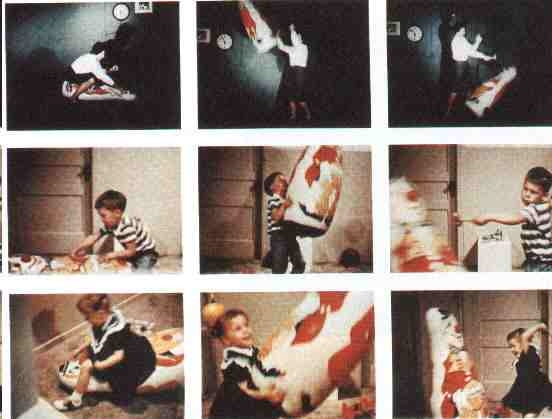
Bandura's Bobo Doll Experiment - Video

Bandura's Bobo Doll Exerpiment is both a classic in observation learning and a study high school psychology students find intriguing. While descriptions and pictures can tell much of the story, an actual video clip brings the experiment to life.

An online 5:02 minute video clip exists which includes Bandura explaining the overall experiment followed by short clips of the adult model and then the children imitating the behavior with Bandura explaining each segment.

I've included a number of links to the video as it seems to appear and then disappear from many websites. The sites which at one time included the video, now state it was removed due to copyright concerns from the Pennsylvania State University.

http://video.google.com/videoplay?docid=-4586465813762682933

http://www.youtube.com/watch?v=vdh7MngntnI

http://alevelpsychology.co.uk/psychology-videos/the-learning-approach/bandura-bobo-doll-video.html

http://www.savevid.com/video/albert-bandura-bobo-doll-experiment.html

http://s239.photobucket.com/albums/ff297/123456789ten_0666/?action=view&current=bobodoll.flv

To find the original journal article from The Journal of Abnormal and Social Psychology (1961) by Bandura, Ross and Ross go to http://psychclassics.yorku.ca/Bandura/bobo.htm

Monday, October 26, 2009

Little Albert: Found!


I haven't read the American Psychologist article about this yet, but this summary from the Mind Hacks blog summarizes the story pretty well: Dr. Hall Beck from Appalachian State University has been trying to track down the identity of "Little Albert" for 7 seven years, and he succeeded! It sounds like the article describes in detail how he used historical records, photographs, and facial recognition experts to figure out the true identity of the baby Watson and Rayner worked with all those years ago. Spoiler alert: don't read the end of the end of the blog post if you want to read the original and find out Albert's fate.

Also, Mary Cover Jones published an article years after the Little Albert study on using classical conditioning to "cure" a child of fears: A Laboratory Study of Fear: The Case of Peter.

Classical versus Operant Conditioning


Jim Biederman from the Anoka-Ramsey Community College, Cambridge and Coon Rapids, MN has developed a number of study aides for his General Psychology students helping them to sort out the the differences between classical and operant conditioning. They include a short document reviewing the types of conditioning, and two sets of examples to help students apply the information to the real world.

Classical and Operant Conditioning Study Sheet
http://www.ar.cc.mn.us/biederman/courses/p1110/conditioning.htm

Conditioning Examples Set 1 - examples and answers on the same sheet
http://www.ar.cc.mn.us/biederman/courses/p1110/examples1.htm

Conditioning Examples Set 2 - examples with answers at a linked location
http://www.ar.cc.mn.us/biederman/courses/p1110/conditioning2.htm

Friday, October 23, 2009

Animal Training at Seaworld

The Seaworld website includes a section on the basics of animal training and how they train the various animals at their parks. The site provides a fantastic explanation of how to apply the principles of operant conditioning to real life situations. The complete guide can also be download as a PDF document.

Seaworld's home page can be found at http://www.seaworld.org/. For the training section or to download the complete infobook, go to http://www.seaworld.org/animal-info/info-books/training/index.htm

Thursday, October 22, 2009

Basketball Playing Rats

On a daily basis, the Center of Science and Industry (COSI) in Columbus, OH includes a live show of two rats who have been conditioned to play basketball.

The COSI website describes the show as "Guests explore conditioning and different ways of learning, and learn about the physical traits of our resident superstars, a pair of Japanese Black Hooded rats. It all leads up to a thrilling game of one-on-one. Cheer your favorite rat on to victory!" To learn more about the shows and the COSI go to http://www.cosi.org/

To see a 47 second video clip of the basketball show go to http://good-times.webshots.com/video/3013527050101930453MtAOYu or http://www.youtube.com/watch?v=2QY2UxBStvo&feature=channel_page

To find a somewhat sketchy description of how the rat are trained go to http://www.rattycorner.com/articles/basketball.shtml

Wednesday, October 21, 2009

Skinner in Life Magazine

Since Kent's midnight postings are currently in the area of operant conditioning I thought I'd look for some articles on B.F. Skinner in the newly released complete archive of Life Magazine on Google Books. Here are some stories I've found:

BF Skinner Foundation

According to their website, "the B. F. Skinner Foundation provides historical information about the life and contributions of B. F. Skinner and supports humane practices based upon his heritage".

The website includes:
  • a biography of Skinner's life
  • a brief article by Skinner, "A Brief Survey of Operant Conditioning", detailing the basics of operant conditioning
  • some photos and video clips of Skinner
  • a complete online book, Science and Human Behavior
The site can be found at http://www.bfskinner.org

Tuesday, October 20, 2009

Squirrel Obstacle Course

This is a short video of a squirrel going through a number of obstacles to reach a simple reward. The clip is a perfect demonstration of many operant conditioning concepts, especially the shaping process.

After classes have viewed the squirrel's work, students, as a class or in small groups, could discuss how to train a squirrel to learn all the many steps in the process.

If the below clip does not work on your computer, do an internet search for "squirrel obstacle course".