Showing posts with label 05 States of Consciousness. Show all posts

Tuesday, November 21, 2017

Hidden Brain: Eyes Wide Open

Just wanted to share two recent episodes of Hidden Brain, an NPR podcast hosted by Shankar Vendantam.

Two episodes from early November 2017 are wonderful overviews about sleep and insomnia including an interview with the infamous Randy Gardner, the record-holder for going without sleep. Though unaffected at the time, Gardner now suffers from severe insomnia.

For students and teachers wishing to learn more about the biology and purpose of sleep, these two episodes are excellent


posted by Chuck Schallhorn

Friday, April 22, 2016

Why We Sleep: A TED Talk

Why We Sleep
·http://www.ted.com/talks/russell_foster_why_do_we_sleep

Russell Foster studies sleep. In fact, he's a circadian neuroscientist, which means he studies what happens to the brain when it does - and doesn't - sleep. This entertaining talk, just under twenty-two minutes in length, covers a range of sleep-related topics from the amount of sleep people typically got before the invention of the lightbulb (hint: a lot more than we get now) to dangers of depriving teenagers of their bed rest. Along the way, Foster asks and tries to answer, the age-old question of why we sleep and explores the relationship of interrupted sleep cycles with mental illness. Subtitles for the talk are available in 36 languages


posted by Chuck Schallhorn

Friday, January 1, 2016

12 Days of Psychology - Day 10: Nightmares vs. Night Terrors

Sadly, I don't spend as much time in the States of Consciousness unit at I'd (or my students) would like due to time. However, I always like to spend time on the disorders of sleep because they're so fascinating and students find them so relevant.

Narcoleptic dog

I absolutely love this article from Scientific American Mind on Nightmares and Night Terrors.  So many good pieces of information in here and kids can easily read it during class and have a great discussion on its contents.

Some of my other favorite sleep disorders links are:

Shaq and Sleep Apnea video

Diagnosing Narcolepsy video 

Sleep Disorders video 

Dangerous Dreamers - REM Behavior Disorder Psychology Today article 

Have a wonderful and restful New Year's Day. (I will need some REM recovery after staying up until 2 am, that's for sure.)

----Posted by Amy Ramponi

Tuesday, February 24, 2015

The Science of Getting Drunk


I know what you are thinking.  What? Our students get drunk?  No way!  Um, I've got news for you. They are and they are binging. I found this little gem last week while on a college tour.  How appropriate, right?

http://www.bitrebels.com/lifestyle/the-science-of-getting-drunk-infographic/

I've never seen it explained this well, so have at it.


posted by Chuck Schallhorn

Saturday, February 14, 2015

Fantastic Drug & Neurotransmitters Chart

I found this fantastic chart from MIT that has an overview of the effects of various drugs on the body. The top portion is licit and illicit drugs.  The portion I took a screenshot from is here.  Simply wonderful overview of the neurotransmitters.  The entire chart is available at this link:
http://ocw.mit.edu/ans7870/SP/SP.236/S09/lecturenotes/drugchart.htm


posted by Chuck Schallhorn

Thursday, February 5, 2015

Your Brain, Love, and Addiction

I recently ran across this article on love that compared being in love to addictions.  They linked to the Rachael Leigh Cook, "This is your brain on drugs" commercial, which was one of my all-teim favorites.  This post was an excuse to share the video.

Here is the article: https://www.psychologytoday.com/blog/love-and-sex-in-the-digital-age/201501/is-your-brain-love
I suspect your students might like or hate this, depending upon their current romantic state.


posted by Chuck Schallhorn

Wednesday, January 14, 2015

The Psychology of Fear and Tough Mudder Races

I was reading my Google News and ran across this gem: The Psychology of Fear: How Tough
Mudder Designs Obstacles to Torture You.

While I do not know anyone who has done a Tough Mudder course, I have had many friends do other obstacle races such as the Warrior Dash.  The article talks extensively about the psychology behind the mental challenges, creating reinforcers to get veterans to come back and newbies to take the challenge.  There are all sorts of psychological issues and ideas discussed in the article, so if you enjoy these races, here is why. :)


Below is their YouTube preview video


posted by Chuck Schallhorn

Friday, November 28, 2014

TV Alert: Sleepless in America on National Geographic

This Black Friday morning, I am watching tv, surfing the web, and avoiding crowds.  I found this commercial about an upcoming show related to sleep.
The website says:
In an unprecedented partnership, NGC along with The Public Good Projects and NIH, America’s foremost scientific authority, will draw the nation’s attention to the science of sleep — a topic fundamental to our collective well-being.
The link to the site with several other video clips is here: http://channel.nationalgeographic.com/channel/drain-the-bermuda-triangle/videos/sleepless-in-america-trailer/
Topics include highway hypnosis, sleep deprivation, sleep after combat, fatigue, and more.

The episodes airs at 8 pm and 11 pm Eastern, 5 pm  and 8 pm Pacific time.

posted by Chuck Schallhorn


Wednesday, November 5, 2014

Brain Games--National Geographic Series

I could have sworn I had posted about this before, but perhaps I had just created a false memory based upon mental repetition of the intent to do so.

If you have not seen these shows, they are fantastic.  The first season begins with hour-long episodes. Seasons two, three, and four have half hour episodes, but each one runs 22 minutes.  The segments are as varied as psychology itself, but ultimately, you will have one of the best resources you can imagine.

Demonstrations I used to create for class or had on old VHS video are now all in high resolution and prepared professionally by editors and graphic artists.  I must say, I am a huge fan of this show. Below are links for you to order them from Amazon.com.  I have seasons 1-3 and have preordered season 4 since I have watched them on tv.  Simply great tv and great psych.  For me, seasons two and three were excellent, but one got me hooked.  Check them out.  You will not regret it.  This is great for both regular and AP Psych.


posted by Chuck Schallhorn


Monday, November 3, 2014

Sleep Videos--Wow! I Had No Idea There Were This Many!

My kids are doing a project on the brain and related topics and creating infographics (more on that in a later post).  One group found some amazing videos on sleep.  Here they are.  Enjoy.


posted by Chuck Schallhorn

Monday, October 13, 2014

Sleeping and Twitching--Why Do We Twitch??

I was doing some other research and shared this find with a couple students doing their own research on sleep.  This has information about the process of neurotransmitters and sleep I was not familiar with.  Great Stuff.
http://news.discovery.com/human/videos/why-do-we-twitch-before-falling-asleep-video-141013.htm


posted by Chuck Schallhorn

Friday, January 10, 2014

Sugar and the Brain

SUGAR!!!!!

A colleague was looking for examples and descriptions for the economic idea of diminishing marginal utility.   He ran across this video on sugar and the brain.  It deals with taste buds, brain parts, dopamine and all sorts of brain and physiology ideas.  It's only 5 minutes and has some fun graphics to keep the kids interested. Not all the various terms we use are in here, but may are referenced. Check it out.


posted by Chuck Schallhorn

Tuesday, September 24, 2013

Rat Park

Psych teacher Scott Miller recently sent me this link to a graphic novel about a psychology experiment. A graphic novel! I didn't know anything like this existed! This is an interesting way to present the complexities of a series of animal studies in a compelling, visual way.

http://www.stuartmcmillen.com/comics_en/rat-park/

The studies were conducted by Bruce Alexander, professor emeritus at Simor Fraser university. Dr. Alexander's bio page links to the wikipedia page explaining the study, so someone there must think that wikipedia is representing the study accurately.

NOTE: I expect there are controversies and complexities galore involved in this study and the researcher's conclusions, so as always, please read through the material thoroughly and use it only if you think it's appropriate for your classroom. Thanks for sending this link my way, Scott!


posted by Rob McEntarffer

Thursday, June 6, 2013

Lucid Dreaming: An Infographic

Another psych find from our friends at http://dailyinfographic.com/.  Their original post can be found here:
http://dailyinfographic.com/how-to-control-your-dreams-infographic

Download or open the graphic in a new window to view it in detail.  This one has a nice sleep stage diagram.  One question I would have is not about lucid dreaming, but about the foods and implications of lucid dreaming.  I have had them on occasion, but have not made a habit of it.  I suspect that this would be a great attention grabber for students.


posted by Chuck Schallhorn

Friday, January 18, 2013

The Secret to Better Sleep: An Infographic

As I get older, my sleep patterns keep changing and I am finding that a complete night's sleep is very elusive.  Sometimes I have early sleep, some time awake and some late sleep.  Napping is always a welcome part of my day.  I receive a daily email about infographics.  A recent one is below (http://dailyinfographic.com/the-secret-to-better-sleep-infographic).  You can find/subscribe to them here:  http://dailyinfographic.com/.  In an upcoming post, I will share some online tools to creating your own infographics.


posted by Chuck Schallhorn

Sunday, December 2, 2012

Hallucinations

I have so much school work to do, but I am having trouble putting down Oliver Sacks' newest book, Hallucinations.  As only Sacks can, he shares stories and insights into this topic.

I suspect most of us keep the idea of hallucinations within the realm of schizophrenia symptoms and drug use, but there are so many other situations in which these occur.

I cannot possibly do justice to the writing or the stories, so I will simply list some topics he delves into.  If you want examples for class or answers to many of your student questions, you may want to check out this book.

  • references to many literature and historical examples
  • brain-induced hallucinations
  • Charles Bonnet Syndrome 
  • sensory deprivation 
  • wine and smells
  • hearing things, including voices
  • Parkinsons-induced
  • Altered States of Consciousness (including Sacks' own experiences)
  • Visual Migraines (migraines-another topic for another book on my shelf of Dr. Sacks)
  • Epilepsy
  • Hypnagogic imagery and hallucinations on the verge of sleeping/waking
  • Narcolepsy
  • Hallucinating oneself
  • Phantom-limb syndrome and other vestiges of parts gone
This book is just a fascinating journey through many stories about people who have had experiences with so many different types of hallucinations.  If you like questioning reality and examining how it can be different for others, this is definitely a book you will enjoy.


posted by Chuck Schallhorn


Wednesday, March 28, 2012

The Scientific American Day in the Life of Your Brain


I was going through my books today and rediscovered a wonderful reference for class.  It's called The Scientific American Day in the Life of Your Brain.  It takes a person from 5 am and waking up, what brain chemicals are activating us and other sensory issues.  It goes on to deal with coming to consciousness, morning emotions, directions to work, facing others, performance at work/stress, decision making, the hungry brain, the tired brain, boredom, pain, exercise, the dimming of the day, getting home from work, music, humor, love and lust, getting to sleep, falling to sleep, sleeping and problems, and people who have to work at night.  The book is at a reading level appropriate for those of use brushing up on brain science as well as high school students.
In short, take any person on any day and the book will have a section on what is happening in a person's brain.  I can imagine a creative teacher, with proper resources, making this a class assignment--what is going on with the brain and rest of the biology of humans during each part of the day, and dividing it up like the chapters/sections of this book.  If you do that, just keep this book hidden ;)


posted by Chuck Schallhorn

Tuesday, December 13, 2011

More than Mouse Party

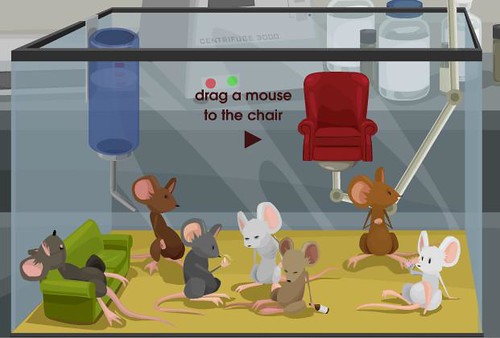
It's not that Mouse Party isn't one of the most amazing websites for teaching about how various drugs affect neural tranmission - CAUSE IT IS - but there's a lot more to this site than just Mouse Party. Check out some other offerings from the Genetic Science Learning Center at the University of Utah:

Oh - did I mention the lesson plans and activities? Oh my!

So - how do you use Mouse Party and these other sites in your class? Have you played Cerebral Commando or used any of these other links? Please share below!

P.S. I could listen to the Mouse Party music all day. Is that wrong?
-- posted by Steve

Saturday, July 30, 2011

New Society for Neuroscience Website--

The Society for Neuroscience has created a wonderful resource that could potentially be utilized by those of us who can get our kids to the internet or for use during snow days or other cancellations.  It could also be used in a webquest.  Wonderful name as well:  "NERVE: Virtual Encycloportal."  I do believe they have engaged in creating a new word, a neologism. 

After the welcome page, the user is directed to this page where there are links to various themes including addiction, anatomy of the brain, and much more as you can see from the graphic on the left.

Each theme has numerous links to other resources that provide an incredible wealth of information and graphical representation of each topic.  One could literally spend days examining all the sites.

In fact, I will be starting my background research for my neuroscience, mental health, and sensation and perception units from this page.  There are just so many incredible resources. 

Do take the time to visit the site and search through the topics. 


Core Concepts in Neuroscience is a booklet that is downloadable for teachers and students to use.  Not only is there the booklet, but there is a short PowerPoint that you can download.

posted by Chuck Schallhorn

Friday, July 22, 2011

Neuroscientist David Eagleman on Colbert Report on 7/21/11

I was catching up on some television watching when I discovered this little nugget.  Dr. David Eagleman has written the book, Incognito: The Secret Lives of the Brain which examines the various processes that occur without the conscious mind being aware.  The reviews on Amazon are mixed, but for those of us who are not in the neuroscience field, it could be a good read.  In the interview, he comes across as a younger, cool, hip and bright neuroscientist.  He does not come off all like the stereotypical stodgy scientist image.  It's a short, fun interview.  Who knows, it may just make a student interested in the brain.

The Colbert ReportMon - Thurs 11:30pm / 10:30c
David Eagleman
www.colbertnation.com
Colbert Report Full EpisodesPolitical Humor & Satire BlogVideo Archive


posted by Chuck Schallhorn