Thursday, October 15, 2009

Pavlov's Biography at the Nobel Prize Website

Many students are surprised to learn Ivan Pavlov won a Nobel Prize. What further surprises them is the prize was NOT given for his research into classical conditioning but for his work in digestion.

The Nobel website includes a short biography of every prize winner since the award's inception in 1901. The Novel biography on Pavlov can be found at http://nobelprize.org/nobel_prizes/medicine/laureates/1904/pavlov-bio.html

Other biographies on Pavlov are at:

http://www.notablebiographies.com/Ni-Pe/Pavlov-Ivan.html

http://en.wikipedia.org/wiki/Ivan_Pavlov

http://www.muskingum.edu/~psych/psycweb/history/pavlov.htm

http://www.biography.com/articles/Ivan-Petrovich-Pavlov-9435332

http://www.thewatershipdown.com/Pavlov%27s%20Biography.htm

Wednesday, October 14, 2009

Constructing Social Reality and Rev. Sun Myung Moon


When in the social psychology unit, I love showing the episode "Constructing Social Reality" from the Discovering Psychology series. This is available at learner.org. Among other things, it has Jane Elliott. But in one short burst of images dealing with cults, the episode shows a stadium of people getting "mass married" by Reverend Sun Myung Moon of the Unification Church. My students are amazed and disbelieving of this as a real event. This morning, on NPR, there was a story about Moon's most recent and possibly last mass wedding.


The story and images capture the immensity of the event and are worth examining within the context of our understanding of reality and cults. The article gives some nice context and insight into the process and the group.

Examples of Classical Conditioning

One of the biggest challenges in teaching the psychology of learning is getting students not only to know and understand the definitions of the unit's major concepts, but apply those same concepts to the real world.

Dr. Jeff Carre at the Cape Breton University, Sydney, Nova Scotia, Canada, has developed a internet based worksheet for his Psychology 211: Learning and General Psychology students. The exercise involves students identifying the UCS, UCR, CS and CR within twelve examples of classical conditioning.

The answers are revealed when the cursor passes over the specific part of the example. Please be aware students need to be very resourceful in their use of the mouse/touchpad on their computer in order to prevent inadvertently calling up an answer to a question different than the one they are working on.

The webpage of Dr. Carre's classical conditioning examples can be found at http://faculty.uccb.ns.ca/gcarre/courses/psy100ccex.htm

Tuesday, October 13, 2009

Concussions and Neural Encephalopathy

One question my students always have is, "what is a concussion?" and "why do they have to stay awake?" after experiencing one. Over the past couple years, I have found these resources.

Last year, Dr. Sanjay Gupta of CNN interviewed the same researcher and had a two-part story about concussions and traumatic brain injury. These links have both text-based and video-based stories.


From the Neuroscience for Kids website:

This link has some good, basic information about concussions:

This past weekend, 60 Minutes aired an episode that dealt with concussions and traumatic brain injuries that athletes suffer. A preview to that story can be found here: http://www.cbs.com/primetime/60_minutes/video/?pid=JTx0jMslQp27eXB8GAqp8_Bm761b4H75

Baby Albert

John B. Watson and Rosalie Raynor's conditioned emotional reactions experiment with Baby Albert is probably one of the most interesting and controversial studies done in the history of psychology. Students are usually amazed at the videos of Watson and Rayner interacting with Baby Albert.

The website, Classics in the History of Psychology (http://psychclassics.yorku.ca/index.htm) has reproduced the original 1920 journal article Watson and Raynor published in the Journal of Experimental Psychology. The reproduced article can be found at http://psychclassics.yorku.ca/Watson/emotion.htm

Monday, October 12, 2009

A musical method for behavior modification

Can you find a way to encourage people to take the stairs instead of the escalator? Volkswagen has an idea.


Where do you find good music?

In January of 2007, the Washington Post did a social experiment about perception. They had Joshua Bell, one of the world top violinists, play during the morning commute at a Washington subway station. Though over 1,000 people walked by, few stayed to listen. The week prior Bell filled a concert hall in Boston with tickets selling for over $100.

The original Washington Post article which includes a short video clip of Bell playing can be found at http://www.washingtonpost.com/wp-dyn/content/article/2007/04/04/AR2007040401721.html

YouTube has a longer video at http://www.youtube.com/watch?v=hnOPu0_YWhw

Go to the Deems Weblog to read an article on the experiment. ( http://deems.wordpress.com/2009/09/29/perception/)

As a quick demo on perception, you might play just the audio portion of the subway video to your classes. Then play the audio of Bell playing in concert (http://www.youtube.com/watch?v=pp-Gl-70dSo. Lastly, show both clips and start what should be a good discussion on perception.

A special thanks to Adina Shmidman PhD, AP Psychology teacher in Bala Cynywd, PA for bringing this experiment to our attention.

Pavlov and The Office

On February 9th of 2007, I remember getting inundated by students who had watched the TV show, "The Office" the night before. It seems the episode had a sequence where Jim classically conditioned Dwight to the sound of his computer booting up. My students were all ecstatic because, not only did the scene show classical conditioning, in one short segment Jim actually talked about Pavlov and his conditioning of dogs.

I've had some interesting discussions with my classes whether the example presented is classical, operant conditioning or a bit of both. Is Dwight being reinforced for putting out his hand when he hears the discriminatory stimulus of the computer OR is the computer sound a CS and putting out the hand a CR? And, what about the strange taste he has in his mouth at the end of the sequence?

For those of you looking to show the clip from the original DVD, you need to find the fifteenth episode of the third season entitled "Phyllis's Wedding". Below I have a number of websites which include the clip. If none of the sites work (I have found it hard to find a site which consistently includes the video due to copyright issues), do an internet video search for Pavlov, The Office, Prank, and/or Altoids.

http://www.strayneuron.com/blog/archives/420

http://www.fanpop.com/spots/the-office/videos/2665014/title/pavlov-prank-office
http://www.youtube.com/watch?v=3kch8ToePPY
http://www.videosift.com/video/The-Office-Dwight-taste-bud-prank-wAltoids

These links are active as of December 15, 2009

http://www.maniacworld.com/Pavlov-Altoid-Theory.html
http://www.savevid.com/video/the-pavlov-altoid-theory.html
http://www.mindhacks.com/blog/2009/10/pavlov_office_style.html
http://vodpod.com/watch/2196374-pavlov-the-office

Sunday, October 11, 2009

Psychoactive Drugs - Part II

Mary Spilis, retired AP Psychology Teacher, now College Board AP Consultant from Charlevoix, MI sent a number of additional links to other sites about psychoactive drugs. All are government sites courtesy of the National Institute of Health. The last link includes a document entitled "Addiction: Drugs, Brains, and Behavior - The Science of Addiction" which can be downloaded as a PDF document." The sites include:

http://www.nida.nih.gov/infofacts/Infofaxindex.html

http://www.drugabuse.gov/PDF/RRPrescription.pdf

http://www.nida.nih.gov/scienceofaddiction/

Thank you Mary for always keeping us up to date on the latest websites.

Friday, October 9, 2009

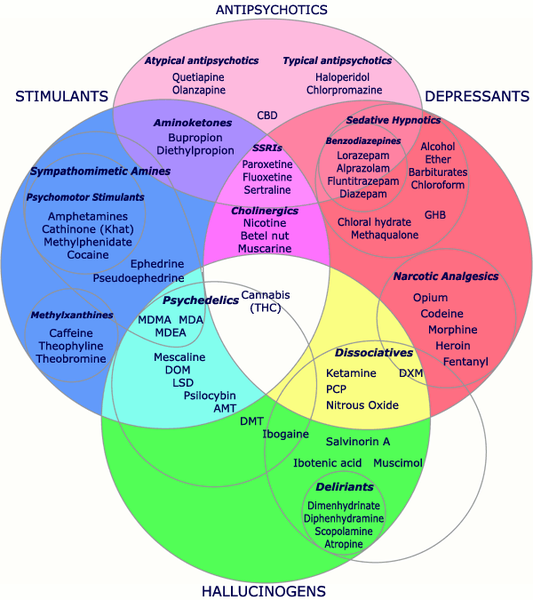
Psychoactive Drug Chart

One of the best ways I have found to present the various psychoactive drugs is with some form of chart. To the right (click on the icon to enlarge) is a very complex Venn diagram as shown on Wikipedia detailing many different types of drugs. DrugNet has a more simplified version at http://www.drugnet.bizland.com/Drug_Info/DrugChart.htm

Near the end of the last school year we had two teachers, Mary Spilis of Charlevoix, MI and Kate Duggan of Herbert Hoover High School, Glendale, CA, shared charts on neurotransmitters each had created. Both charts can be downloaded at the 4Shared file sharing account at http://www.4shared.com/dir/10555367/29577282/sharing.html

I am hoping to recreate that same type of collaboration this year. If you are willing to share a chart of psychoactive drugs you have developed, please feel free to upload it to the 4Shared site at the address listed above or, if you would prefer, feel free to email me (Kent Korek - kkorek@germantown.k12.wi.us) the chart and I would be happy to upload it to the 4Shared account. Please respect the work of others and do NOT upload a chart from a text or someone's website.