Showing posts with label vision. Show all posts

Wednesday, November 18, 2009

Sensation and Perception


When I began teaching this topic, I was scared because I had no idea what I was doing. I'd never had an S&P course in college and this seemed a little daunting. Over the years, with a lot of hard work, some research, and some wonderful internet sites, I learned and learned.


Today, I'd like to share and highlight the work of John H. Krantz of Hanover College in Southern Indiana. For years, he has been at the forefront of taking concepts online in an interactive format for students (and teachers). This site is about sensation and perception and its constituent parts. While I cannot use all the illustrations in an introductory course, there are some great specific ones I can use. Be sure to have the latest Java to help your experience.

Experiencing Sensation and Perception (includes cognition and neuroscience links)


There is lots more on this tremendous site. Poke around a bit and see what you can use.

Wednesday, September 23, 2009

Exploritorium Sensation and Perception Exhibits

If you have never had the opportunity to check out the Exploratorium Page, block off the next three months and go to http://www.exploratorium.edu/ For those not having that kind of time, go to http://www.exploratorium.edu/exhibits/nf_exhibits.html to view a number of exhibits (activities) specific to sensation and perception.

The exhibits for Seeing include:
  • Mix-n-Match - You can mix just three colors of light to make over 16 million different colors!
  • Depth Spinner - Does it feel like the walls are closing in?
  • Changing Illusions - Tease your brain with five interactive illusions.
  • Fading Dot - If you stare at this dot, for few moments it disappears
  • Cafe Wall Illusion - Interact with the Cafe Wall Illusion.
  • Postcard Exhibits - Four exhibits small enough to fit on postcards.
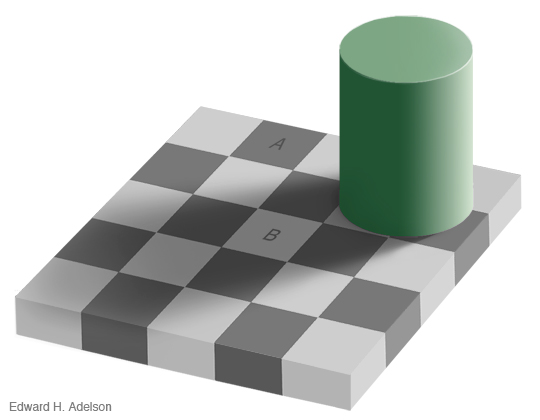
  • Sliding Gray Step - Is it light gray or dark gray? It depends on the surroundings.
  • Shimmer - Your eye movements make this design seem to shimmer.
  • Trapezoidal Window - Sometimes things are not as they appear.
  • Bird In A Cage - When your color vision tires, you can see colors that aren't really there.
  • Squirming Palm - Can you make your palm squirm?
  • Mona - Leonardo's famous model is used in an interesting perceptual experiment.
  • The Temple Illusion - This ancient temple holds a secret...can you reveal the mystery?
The exhibits for Hearing include:
Please be aware many of the above activities require a specific program (Shockwave, QuickTime VR, or Real Audio). As you have time, explore the other exhibits on the page especially those in the Mind section.

Tuesday, September 22, 2009

Seeing, Hearing and Smelling the World

The Howard Hughes Medical Institute has developed a website with a number of articles on sensation with a special emphasis on the brain. The list of articles can be found by clicking on the icon to the left.

The "New Imaging Techniques That Show the Brain at Work" article would work well in the Biological Influences Unit. Seeing, Hearing and Smelling the World can be found at http://www.hhmi.org/senses/


Friday, September 18, 2009

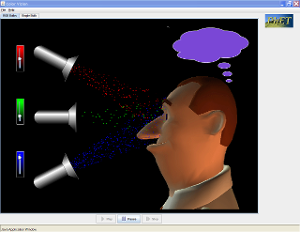
Additive Color Vision Simulation

The University of Colorado at Boulder had developed a number of interactive simulations. Unfortunately, all but one are geared more towards science and math classes rather than psychology. The one psychological simulation involves color vision which does a fantastic job of demonstrating the trichromatic color theory as well as the concepts of additive color.

Users can adjust the intensity of red, green and blue colored lights to see the effects on the subjects vision.

All of the simulations require the use Java 1.5 which can be downloaded for free from a link on site. To find the vision color simulation, simply go to http://phet.colorado.edu/simulations/sims.php?sim=Color_Vision#topics.

Thursday, September 17, 2009

Simulations of Vision Loss

Within the Ohio Lions Eye Research Foundation's (OLERF) website a page is devoted to various types of vision loss. The site tries to describe and simulate what each impairment would be like both visually and textually. A complete list, with hyperlinks, of each vision loss difficulty included on the site is listed below or you can go to http://www.ohiolionseyeresearch.com/simulati.htm#Normal%20View for the complete listing.