 The Brain, along with Pinky's help, does a quick (1:22) run through of the major parts of the brain. If the below video fails to work, do an internet search for "Pinky and the Brain" "parts of the brain". There are a number of sites (YouTube has at least two versions) of the clip.
Wednesday, September 9, 2009
Parts of the Brain by Pinky and the Brain
The Brain, along with Pinky's help, does a quick (1:22) run through of the major parts of the brain. If the below video fails to work, do an internet search for "Pinky and the Brain" "parts of the brain". There are a number of sites (YouTube has at least two versions) of the clip.

Tuesday, September 8, 2009
Brain Plasticity Video
 This video clip, from the Discovery Channel and McGraw-Hill Higher Education details how the brain can "repair" itself. The video centers around the story of Jody Miller who had a hemispherectomy, the removal of one half of the brain, to control her epileptic seizures.
The clip can be found at any of the following sites.
- http://www.youtube.com/watch?v=TSu9HGnlMV0
- http://www.youtube.com/watch?v=u2c-WHVxcfY
- http://www.dnatube.com/video/1302/Brain-Plasticity
- http://www.twine.com/item/11m0kr3vz-259/youtube-brain-plasticity
Monday, September 7, 2009
Animated Tutorials: Neurobiology/Biopsychology
Sumanas Inc has created a number of animations to help explain the basics of neurobiology/biopsychology. A complete list of animations can be found below.
Please be aware some of the animations need the Adobe Shockwave plug-in which can be downloaded at Shockwave. Intel-based Macintoch users should be sure to read the special TechNote regarding the Shockwave Player.
The neurobiology/biopsychology page can be found below or at http://www.sumanasinc.com/webcontent/animations/neurobiology.html.
To examine the complete set of animations from Sumanas Inc. go to http://www.sumanasinc.com/webcontent/animation.html
 Neuronal Development |  Synaptic Transmission |
 The Action Potential |  Electrical Signaling in Neurons |
 Sensitization in Aplysia |  The Voltage Clamp Method |
 AMPA and NMDA Receptors |  Sound Transduction |
 The Vestibular System | 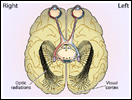 Visual Pathways in the Human Brain |
 Receptive Fields in the Retina |  Reflex Arcs |
 Receptors of the Skin |  Positron Emission Tomography (PET) |
Saturday, September 5, 2009
High School Level Textbook Survey
While the market for AP Psychology textbooks has many options, the high school level choices are fairly small. Below is a survey of the common texts used today. The current results of the survey will be revealed once you cast your vote.
If you answer with either of the last two choices (other and none of the above), please feel free to leave a note in the comment section as to which text you use. I am confident a number of people would be interested in what other texts teachers are using.
N=219 as of 01/27/12.
Thanks to all those who have participated.
Friday, September 4, 2009
BrainExplorers.com
 This is one more interactive website devoted to the brain. Sponsored by the Lundbeck Institute in Denmark, the site includes basic information on neurons, neurotransmitters, the brain and nervous systems. Many students might find the "Focus on Mental Disorders" interesting. The main page of the site can be found at http://www.brainexplorer.org
Phineas Gage: Newly Discovered Picture
 Recently, a picture believed to be that of Phineas Gage holding the tapping iron which pierced his skull has surfaced. For thirty years Jack and Beverley Wilgus have own the photograph not knowing its significance. The possibility of the shot being of Gage came out when they placed it on Flickr, a picture sharing website. The couple have written an article, "Face to Face with Phineas Gage", for the July 2009 issue of the Journal of the History of the Neurosciences (http://www.tandf.co.uk/journals/titles/0964704X.asp) or go to http://brightbytes.com/phineasgage/index.html.
Newspaper and blog accounts of the photograph can be found at:
LA Times Website
http://www.latimes.com/news/nationworld/nation/la-sci-gage16-2009jul16,0,6843461.story
The Boston Globe Website
http://www.boston.com/news/local/massachusetts/articles/2009/07/22/newly_discovered_image_offers_fresh_insights_about_1848_medical_miracle/
The New York Times Website
http://tierneylab.blogs.nytimes.com/2009/07/22/the-curious-case-of-phineas-gage-refocused/
Advanced in the History of Psychology Blog
http://ahp.apps01.yorku.ca/?p=730
The Neurophilosophy section of the Science Blogs
http://scienceblogs.com/neurophilosophy/2009/07/meet_phineas_gage.php
The September 2008 issue of The Psychologist from the British Psychological Society, includes an article which deputes many of the common beliefs of Gage's story at http://ahp.apps01.yorku.ca/?p=515#more-515
A special thanks to Tack Chace, Shrewsbury High School, Shrewsbury MA, whose initial posting on the AP Psychology Electronic Discussion Group provided the impetus for this posting.
Thursday, September 3, 2009
How Stuff Works - The Brain and Central Nervous System
 This is the first of three postings from the "How Stuff Works" website. In this installment, the site explains the workings of the Brain and Central Nervous System. Click on any of the links below to go to:
- The main homepage at http://www.howstuffworks.com/
- The health subdivision page at http://health.howstuffworks.com/
- The anatomy channel page at http://health.howstuffworks.com/anatomy-channel.htm
Explore These Topics:
Wednesday, September 2, 2009
Making a Candy Neuron
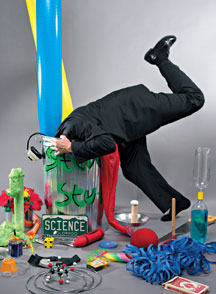 This activity, from the Steve Spangler Science website, is obviously designed for an elementary level science class. Students, in groups, use candy to create a facsimile of a neuron.
I know that many high school psychology teachers do similar activities having students create neurons or brains from candy, clay, pasta, jello, paper, etc. If you do such an activity, please post it in the comments section or email it to me (Kent Korek - kkorek@germantown.k12.wi.us) and I will be happy to post it to this blog.
The activity's description can be found at http://www.stevespanglerscience.com/experiment/candy-neuron.
Brainsrule.com has a variation of the activity at http://www.brainsrule.com/pdf/neuron_cookie.pdf
Neuroscience for Kids shows a number of different materials at http://faculty.washington.edu/chudler/chmodel.html
Neuron and Brain Review Exercise
 Jeff Hargett, a teacher at Rome High School (Rome, GA) has developed some simple review exercises for his biology and anatomy students. His reviews for neurons, the brain, the eye, and the ear are all applicable to a psychology course.
Click any of the links below (note the brain quiz includes a model and diagram version), http://rcs.rome.ga.us/hargett/anatomy/nervous/index.htm includes the main page for the the neuron and brain reviews, or, for a complete listing of reviews, go to http://rcs.rome.ga.us/hargett/. Reviews for the eye and ear will be posted later in the year.
Brain model
Brain model quiz
Brain diagram quiz
Tuesday, September 1, 2009
The Brain from Top to Bottom
 Exploring this website completely would probably take most of a school year. While the title suggests the site should be used in the biological influences unit, it could be used within a multitude of units within any psychology course. The site can be found at http://thebrain.mcgill.ca/
Before exploring the site, read through the "user's guide" and "site manual".
Subscribe to:
Posts (Atom)
