Friday, January 23, 2015

Perspectives in Psychology Practice Questions

When it comes to perspectives, my students for some reason, seem to have difficulty.  Sometimes I will make the unit at the beginning of the semester for regular psych.  Sometimes I will incorporate and integrate the ideas throughout the course and summarize after we've done some units.

Below is a sheet that I created to help my kids practice.  After going over the main perspectives, reading in and out of the text, outside outlines from Britain, a chart that Drew Appleby created and more, I use this sheet to see how well they understand the major points of view--psychoanalytic, behavioral, cognitive, humanistic, biological, and sociocultural (my book is from 2003). I have them do it as homework, but we go over it as a class and I help them identify key words in the clues.

A Word Version Linked Here
Key to Doc-Word Version


Perspectives Practice Questions                   Name                                                                           Block              

Below are a set of scenarios and ideas that a psychologist from a particular perspective might use.  Choose the best perspective of the following:  Psychodynamic, Behavioral/Learning, Cognitive, Humanistic, Biological, Socio-cultural/social psychological.
Scenario
Perspective
1.      When looking at why a person chooses to behave a particular way, I will examine how they think and process information.

2.      When looking at why a person chooses to behave a particular way, I will examine what happened in childhood and what kinds of issues the patient is fixated on.

3.      When looking at why a person chooses to behave a particular way, I will examine the brain chemistry and hormonal issues of the person.

4.      When looking at why a person chooses to behave a particular way, I will examine if the behavior helps the person reach his/her own potential.

5.      When looking at why a person chooses to behave a particular way, I will examine what consequences (pleasant or unpleasant) the person experienced.

6.      Examining how a person’s gender will affect their actions.

7.      The unconscious mind influences everything we do.

8.      How do people remember and forget?

9.      Depression is influenced by genetic predisposition and brain chemistry.

10.  Depression is influenced by how we perceive the work and how our thoughts can betray us.

11.  Depression is the result of not being able to express our anger toward those at whom we are angry, so we “swallow” it, leading to depression.

12.  Depression is the result of the depressive behavior being reinforced by important others in our lives.

13.  Depression is caused when an individual has a specific self-concept, but important others in our lives have different views of who we are and what we should be.

14.  When we watch important people in our lives being depressed, we imitate it.

15.  Recent research has found that being a part of any ethnic group changes the way our brains are wired.  This has two answers.

16.  Examining the structures of the brains of schizophrenic twins and comparing them to their healthy twins.

17.  What makes people watch a commercial repeatedly, then go out and buy a product?  There are multiple responses here.

18.  We are constantly trying to become who we are.  Our lives are a process of growth.

19.  There seem to be a few things that motivate people:  hunger, thirst, and sex.  Examining the hormones of each uses this perspective.

20.  Analyzing dreams is a part of this point of view.

21.  An individual’s behavior is connected to a person’s feelings and self-image.

22.  Examining how an eyewitness will interpret a situation and how a lawyer can best cross-examine that witness.

23.  Using drugs to treat various mental illnesses such as schizophrenia, anxiety, and depression.

24.  When parents use punishment to change their child’s behavior, they are using a technique from this perspective.


25.  When learning song lyrics, you are using techniques from this perspective.

26.  How the body and brain creates emotions, memories, and sensory experiences.

27.  Examining the whole person, not just their biology or culture—we need to examine the entirety of a person and his/her perceptions of their world.

28.  Looking at thinking and the “unconscious mind” is folly.  Psychology should examine only observable behavior.

29.  The biggest influence on personality is what happens to us from birth to five years.

30.  The biggest influence on personality is a person’s genetics.

31.  The biggest influence on personality is a person’s culture.

32.  Individual free will is more important for a person becoming who they are as any other factor.

33.  Our mind uses defense mechanisms to reduce anxiety when we face uncomfortable realities.

34.  Teachers will attempt to make the classroom a “safe place” so you can maximize your comfort level and learn more effectively.

35.  Schools provide meals for students so they can avoid hunger and be able to learn more effectively.

36.  Teachers will often get some students to study more by offering extra credit

37.  If you show the same picture of a house on a hill to a Maori and to someone from Iowa, the Maori is more likely to be interested in the hillside, while the Iowan is more likely to be interested in the house.

38.  The reason students will act inappropriately in school is because of how they were raised in their home environment—they never learned how to behave properly but were reinforced to act without manners.

39.  A student tells a teacher to “f-off” while walking out of class.  The reason for that was because the student under the influence of an illicit substance.

40.  A student plays the role of “class clown” in one class and the role of “brain” in another class.  This approach explains it by examining a student’s interpretations of how well the student assesses his/her own abilities in each subject.

41.  A student realizes that she and her boyfriend just cannot continue dating—he really like monster truck races and working on his car.  She prefers the finer things in life such as gourmet foods and expensive clothes/fashion.  They just cannot agree on what to do together.  They come from two different worlds.

42.  A sports psychologist will work with an athlete to help him/her visualize the proper mechanics of the sport to improve performance.

43.  An athlete knows that there will be a bonus if s/he scores more than 25 points in this last game.  Which perspective is being utilized?

44.  David Eagleman wrote “Incognito: The Secret Lives of the Brain.”  From which perspective does he write?

45.  As children, we need unconditional positive regard (acceptance without anything in return) in order to grow up and become healthy adults.

46.  Daniel Kahneman wrote “Thinking, Fast and Slow.”  From which perspective is he writing?

47.  Your psychology teacher likes to spend lots of time running and hiking because of how it makes him feel.  He always feels physically better after he works out.  Which two perspectives can explain this?


posted by Chuck Schallhorn


Thursday, January 22, 2015

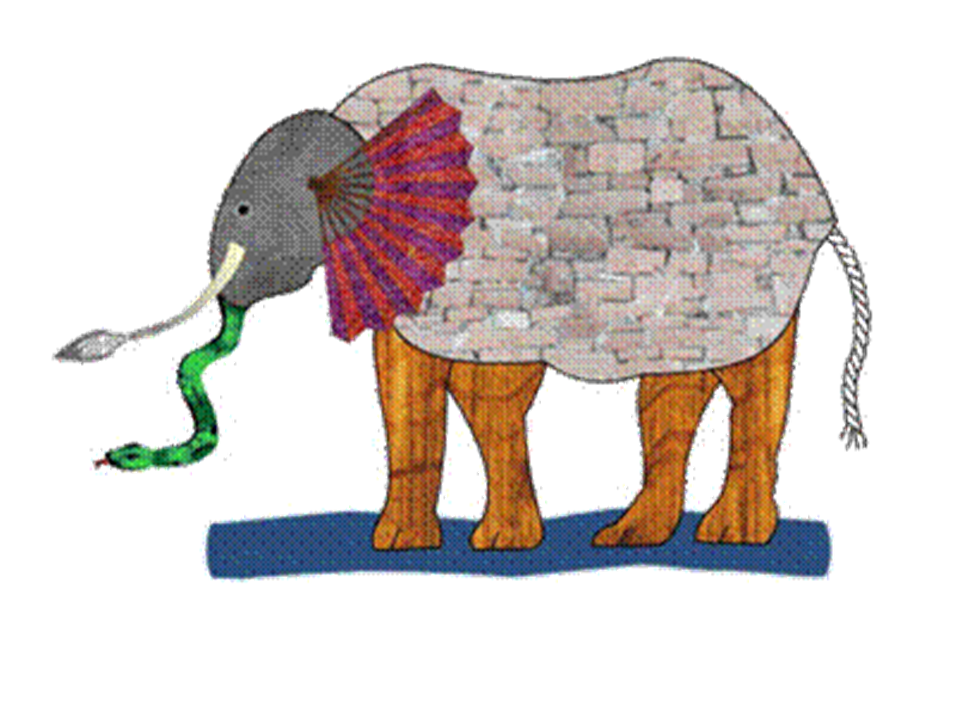
The Blind Men and the Elephant: Poetry to Illustrate Perspectives

In the beginning of my courses, I like to use this poem by John Godfrey Saxe called, The Blind Men and the Elephant.  Sometimes it is called, The Six Men of Indostan.

I read the poem as I show it on the front screen.  I ask the students to discuss the meaning of the poem.  The higher the level of student, the better your responses are likely to be.

I liken the six men as the six main perspectives of psychology.  They are looking at the same behavior, but each is limited by its own definition and focus, just like the blind men. "Though each of them were partly right, and all were in the wrong."

A PowerPoint version of the poem can be found here:


posted by Chuck Schallhorn

Wednesday, January 21, 2015

Attribution of Responsibility: Blaming the Victim--A Lesson

This activity is originally from Doug Bernstein of the University of Illinois.  I received it at one of the
Midwest Teaching of Psychology Conferences in the 1990s.  The first part of the lesson is his.  The second part is my take on teaching attribution.

I will often use this activity at the beginning of the social psychology unit before the students have read about attribution.  But over the years, no matter when it occurs, most students still have the reaction Bernstein talks of.  Usually, the majority of my students will blame the wife.

Process:
1) I tell the students I have a story to read them and ask them to have a blank sheet of paper and writing implement.  They are going to answer a couple questions afterward.
2) I read the story (explaining that a highwayman is an old term for mugger) and end the story abruptly
3) I ask the question, who is responsible--rank the six characters from most to least responsible
3a) NO TALKING YET
4) Because of memory issues, I usually put this on the board:
   -wife
   -husband
   -L1
   -L2
   -Ferryboat Captain
   -Highwayman
5) I then ask who put the FB captain first, then L1, L2 , husband, then wife.  This is where lots of hands go up
6) I then ask for who said the highwayman was most responsible--a few hands
7) I then ask those who said the wife was most responsible to explain.  Depending upon the class, I will get some really clear responses, but not always. I try to clarify if they are not
8) I then ask those who said that the highwayman was most responsible why the rest of the class was wrong.  This really increases emotions on those who feel the need to defend their position and can create a great discussion

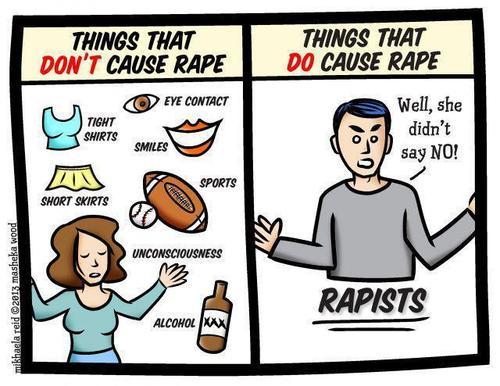
At this point, some or most of the students will get it.  I try to add other contexts such as blaming people for being poor or blaming rape victims. I use this second one with great care due to so many having had that experience happen to them.  It has sparked some heated discussions in the past.


Attribution of responsibility: Blaming the Victim

Defensive attribution refers to the tendency to blame victims for their own misfortune (Weiten & Lloyd, 1994). To view victims as somehow having "asked for it" allows observers to maintain a belief in a "just world" in which people get what they deserve and deserve what they get (Lerner & Miller, 1978). Defensive attribution also allows people to sustain the comforting illusion that they themselves are unlikely to suffer a similar catastrophe.

This exercise was developed by Bloyd (1990) and is based on the following story, taken from Dolgoff and Feldstein (1984):

Once upon a time, a husband and wife lived together in a part of the city separated by a river from the places of employment, shopping, and entertainment. The husband had to work nights. Each evening he left his wife and took the ferryboat to work, returning in the morning.

The wife soon tired of this arrangement. Restless and lonely, she would take the next ferry into town each evening and develop relationships with a series of lovers.  Anxious to preserve her marriage, she always returned home before her husband. In fact, her relationships were always limited. When they threatened to become too intense, she would precipitate a quarrel with her current lover and begin a new relationship.

One night she caused such a quarrel with a man we will call Lover I. He slammed the door in her face, and she started back to the ferry. Suddenly she realized that she had forgotten to bring the money for her return fare. She swallowed her pride and returned to Lover 1's apartment to borrow the fare. After all, she did have to get home. But Lover 1 was vindictive and angry because of the quarrel. He slammed the door on his former lover, leaving her with no money. She remembered that a previous lover, who we shall call Lover 2, lived just a few doors away. Surely he would give her the ferryboat fare. However, Lover 2 was still so hurt from their old quarrel that he, too, refused her the money.

Now the hour was late, and the woman was getting desperate. She rushed down to the ferryboat and pleaded with the ferryboat captain. He knew her as a regular customer. She asked if he could let her ride free and if she could pay the next night. But the captain insisted that rules were rules, and that he could not let her ride without paying the fare.

Dawn would soon be breaking, and her husband would be returning from work.      The woman remembered that there was a free bridge about a mile further on. But the road to the bridge was a dangerous one, known to be frequented by highwaymen. Nonetheless, she had to get home, so she took the road.  On the way, a highwayman stepped of the bushes and demanded her money. She told him she had none. He seized her. In the ensuing tussle, the highwayman stabbed the woman, and she died.

Thus ends our story. There have been six characters: husband, wife, Lover I, Lover II, ferryboat captain, and highwayman. We would like you to list, in descending order of responsibility for this woman's death, all the characters. In other words, the one most responsible is listed first; the next most responsible, second; and so forth.

Typically, about half the students will list the highwayman first and half will list the wife first (although the other characters in the story are occasionally assigned primary responsibility for the wife's death). In other words, students are just as likely to blame the ·victim for her own murder as they are to blame the perpetrator of the crime. If the wife was stupid enough to walk dangerous streets alone at night, they say, then perhaps her fate was only what she deserved. Furthermore, the highwayman was behaving in a manner entirely consistent with his role as "career criminal"; but the victim, by taking a succession of lovers and deceiving her husband, clearly overstepped the bounds of her role as wife.

An interesting variation on this exercise is to rewrite the story such that the victim is a widow who works nights to feed her children, and must get home in time to relieve the babysitter. In this case, the vast majority of students will assign primary responsibility for the murder to the highwayman rather than the victim--despite the fact that the perpetrator's behavior is identical in both stories.


References

Bloyd , J.R. (1990). Blaming the victim. Presented at the Seventh Annual Mid-America Conference for Teachers of Psychology, University of Southern Indiana, Evansville, Indiana.

Dolgoff, R., & Feldstein, D. (1984). Understanding social welfare (2nd ed.). New York: Longman.

Lerner , M.J., & Miller, D.T. (1978). The belief in a just world: A fundamental delusion. New York: Plenum.

Weiten, W ., & Lloyd , M.A. (1994). Psychology applied to modern life: Adjustment in the'90's (4th ed.). Pacific Grove, CA: Brooks/Cole.


Follow-up
Just world hypothesis--ideas that make us feel better about the world to keep us in a relative state of low anxiety and denial.  We want to believe that bad things only happen to bad people so we conveniently think that we, ourselves, are good people, so bad things are not likely to happen to us, e.g. I will not get into an accident while driving while impaired or texting; I will not get pregnant or a disease while having sex because that only happens to sluts; etc.

After the long discussion, I present the idea of attribution.  I use the chart below to create a basic understanding of internal and external attributions/explanations for their own and other people's behavior.


I then share these examples and examine them as a class:


In addition to internal and external, there is also stable and unstable—for our purposes, we are not concerned with that, though you will encounter it in college.

Examples may include:

If you fail a test, you could say, “I suck at tests” which is internal and stable
OR
You could say, “I had a bad day and was tired” which is internal and temporary/unstable—can lead to a greater effort later
OR
“I failed because I am just not that smart” internal and stable—the person is less likely to study later

Explanations of sports teams we support and why they succeeded or failed (especially good around playoff time for major sports or during March Madness)

Our (white people’s) explanations of why we did not get into college (or get a scholarship)

Our explanations of why people of our own gender or ethnic group are successful (or not)

OR

Parents' explanations of their own child's trouble in class versus the other children

External Attributions
For losing a game:
  • they could discuss how the field may have been slippery or the referees were making bad calls.
  • One also might talk about the sun being in their eyes
  • there was too much noise or too little.

External attributions for winning a game would be
“The team played as one”.

Internal attributions for losing a game might be
“I did not kick the ball hard enough”
“I could have played better defense”

Fundamental Attribution Error (FAE)--I then go over this concept with the class.  We tend to underestimate the impact of situational factors when understanding/explaining people's behaviors. Awareness can help us reduce this error.


******If you have additional ideas or alternate ideas on how to teach attribution, please let me know.  If you have a lesson to share, let's make you a guest blogger.


posted by Chuck Schallhorn

Tuesday, January 20, 2015

Grant Alert--TOPSS Funding Opportunities

For those who are not already a member, Teachers of Psychology in Secondary Schools is a major
source of great people, great teaching ideas, and lesson plans.

You can find the resources and a way to sign up at this link: http://www.apa.org/ed/precollege/topss/


Here are the latest opportunities:


APF Professional Development Awards for High School Psychology Teachers

The Professional Development Awards for High School Psychology Teachers provide up to $500 in support to help psychology teachers travel to and attend the APA Annual Convention, Aug. 6-9, 2015, Toronto. Funds can be used to offset costs of travel, conference registration, and housing accommodations. Applicants must provide a budget for conference costs. These grants are made possible through the American Psychological Foundation, thanks to a generous gift from Lee Gurel, PhD. $2,500 is available for funding.

Please visit http://www.apa.org/apf/funding/professional-topss.aspx for details.  The application deadline is April 1, 2015. 

APF High School Psychology Teacher Network Grants

These APF grants support the development of local and regional networks of high school psychology teachers.  Specifically, these grants are meant to support the creation or continuation of local or regional teaching workshops or conferences for high school psychology teachers.  For information on strategies for setting up a local teaching network and details on existing groups, please see http://www.apa.org/ed/precollege/ptn/2014/05/local-psychology-teachers.aspx or http://www.apa.org/ed/precollege/topss/state-local-groups.aspx.

For details on how to apply, please visit http://www.apa.org/apf/funding/psychology-teacher-network.aspx for details.  APF will award $3,000 in grants in 2015.  The application deadline is May 1, 2015.


posted by Chuck Schallhorn

Wednesday, January 14, 2015

Reader Survey: Teaching High School Psychology

Here at Teaching High School Psychology, we want to be as useful as possible.  To that end, we are asking that you fill out this brief survey to help us hone the direction(s) we move in.  Results are anonymous unless you choose to add your name/email.

Please take the two to three minutes to help us out.  We really, really, really appreciate your help!!!


posted by Chuck Schallhorn

The Psychology of Fear and Tough Mudder Races

I was reading my Google News and ran across this gem: The Psychology of Fear: How Tough
Mudder Designs Obstacles to Torture You.

While I do not know anyone who has done a Tough Mudder course, I have had many friends do other obstacle races such as the Warrior Dash.  The article talks extensively about the psychology behind the mental challenges, creating reinforcers to get veterans to come back and newbies to take the challenge.  There are all sorts of psychological issues and ideas discussed in the article, so if you enjoy these races, here is why. :)


Below is their YouTube preview video


posted by Chuck Schallhorn

Tuesday, January 13, 2015

Hidden Within Symbols

Quick post on a repeat topic, but here are many logos all in one place from our friends at Daily Infographic:

You can find their post here: http://dailyinfographic.com/40-brand-logos-with-hidden-messages-infographic

I could not embed the picture, so do take a look at it from their site.


posted by Chuck Schallhorn

Friday, January 9, 2015

Upcoming Psychology Conferences

Good day everyone,

I have permission from Emily Leary to share this information with you.  Here are some upcoming conferences that contain some incredible professional development. If you can go, please do, you will make some great connections and learn some valuable lessons.

This is from the following link:
http://www.apa.org/monitor/2015/01/regional-meeting.aspx


Eastern Psychological Association

March 5–7, Philadelphia
This year's invited speakers include:
  • Irving Kirsch, PhD, Harvard Medical School, "The Emperor's New Drugs: Informing the Public about the Hidden Data."
  • Eric Landrum, PhD, Boise State University, "Undergraduate Psychology Education and our Collective Legacy at Risk."
  • Scott Lilienfeld, PhD, Emory University, "Psychopathic Personality: Scientific Consensus, Scientific Controversy."
  • Robert Kurzban, PhD, University of Pennsylvania, "On Having the Willpower to Abandon the Resource Account of Willpower."
  • Kirk Heilbrun, PhD, Drexel University, "The Technology of Psychology: Where Are We and Where Do We Go From Here?"
  • Daniel Wagner, PhD, University of Pennsylvania, "Learning as a Psychological Concept, and as an International Policy Goal: Shared Meanings, Shared Actions?"
  • Justin Harris, PhD, University of Sydney, Australia, "The Laws of Conditioning: Doing Time for Guilt by Association."
  • Art Markman, PhD, University of Texas, "Exploration and Exploitation: A Journey from the Lab to the World."
  • Tracey Shors, PhD, Rutgers University, "Mental and Physical Skill (MAP) Training: A Neurogenesis-Inspired Intervention that Enhances Health in Humans."
  • Bill Fifter, PhD, Columbia University, "Early Origins: Neurobehavioral Development in the Fetus and Newborn."

Southeastern Psychological Association

March 18–21, Hilton Head, South Carolina
Highlights from the SEPA meeting include:
  • Deborah Best, PhD, Wake Forest University, "Culture and Socialization of Gender."
  • Steve Kass, PhD, University of West Florida, "Driver Attention: Findings and Future Directions."
  • Scott Lilienfeld, PhD, Emory University, "50 Great Myths of Popular Psychology."
  • Marilyn Carroll, PhD, University of Minnesota, is the APA 2015 Distinguished Scientist Lecturer.
  • Dawn M. Szymanski, PhD, University of Tennessee, is the CEPO Invited Speaker on Heterosexism and Lesbian, Gay, and Bisexual Persons' Psychosocial Health.
  • Jordan Troisi, PhD, Sewanee: The University of the South, is the Society for the Teaching of Psychology's Invited Speaker, "Navigating the Life of the Mind (Together): A Scholarly Look at Pedagogy, Relationships, and the Intersection of the Two."
  • Peter Giordano, PhD, Belmont University, the Psi Chi Distinguished Lecturer, "Identity Development in College Students: Can Random Comments Change Lives?"
  • Tara Collins, PhD, Winthrop University, the Psi Chi Invited Speaker, "Toward a More Comprehensive Understanding of ‘In-Between' Sexual Orientations."
At the SEPA 2015 conference, there will also be an APA Academic Career Workshop, as well as multiple continuing-education workshops.

Rocky Mountain Psychological Association

April 8–11, Boise, Idaho
Among this year's highlights are:
  • Erin Bigler, PhD, Brigham Young University, is the Distinguished Lecturer.
  • Charles Honts, PhD, Boise State University, will deliver the Past President's Address.
  • Brian A. Nosek, PhD, University of Virginia, will deliver the Presidential Address.
  • William Douglas Woody, PhD, University of Northern Colorado, will deliver the Second Annual RMPA Alumni Address.
  • David Myers, PhD, Hope University, is the invited diversity speaker.
  • Lori James, PhD, University of Colorado, is the G. Stanley Hall Lecturer.
  • Stan Coren, PhD, is the Gardner Memorial Lecturer.

Southwestern Psychological Association

April 10–12, Wichita, Kansas
With a convention theme of "Myth Meets Science," invited speakers will explore ways their research uses the scientific method to debunk myths. Speakers include:
  • Scott Lilienfeld, PhD, Emory University, "Distinguishing Science from Pseudoscience in Psychology: Implications for Everyday Life."
  • Norbert Schwarz, PhD, University of Southern California, "The Challenge of Debunking Myths: When Weird Ideas Feel True."
  • Regan A.R. Gurung, PhD, University of Wisconsin–Green Bay, "Wearing Our Personalities? Examining Clothing Myths, Impression Formation and Objectification."
  • Travis Langley, PhD, Henderson State University, "The Filter of Fiction: How Batman, Buffy, Breaking Bad, and More Teach Real Psychology."
  • Heather Berlin, PhD, Mount Sinai School of Medicine, "The Neuroscience of Free Will: Legal Implications."
  • Baba Brinkman: Canadian rap artist Baba Brinkman is best known for his award-winning hip-hop theatre shows, including "The Rap Guide to Evolution" and The "Canterbury Tales Remixed," which interpret the works of Darwin and Chaucer for a modern audience. He will perform an educational rap on myths in evolutionary psychology.
SWPA affiliate programming includes:
  • Southwestern Teachers of Psychology: Stephen Chew, PhD, Samford University, "The Tragedy of Teaching Psychology: The Slaying of Ugly Facts by a Beautiful Myth."
  • Society for Applied Multivariate Research: John Bardo, PhD, Wichita State University, "The Myths of Economic Development: Reshaping a regional economy on university-based innovation."
  • Psi Chi: Pamela Keel, PhD, Florida State University.

Midwestern Psychological Association

April 30–May 2, Chicago
The Midwestern Psychological Association Meeting will feature papers, posters, workshops and discussion sessions from researchers across the Midwest and around the world. This year's invited speakers include:
  • John B. Pryor, PhD, Purdue University, MPA Presidential Address.
  • Susan T. Fiske, PhD, Princeton University, Psi Chi Distinguished Lecture.
  • Michael J. Dougher, PhD, University of New Mexico, APA G. Stanley Hall Lecture.
  • Roy Baumeister, PhD, Florida State University.
  • Brian A. Nosek, PhD, University of Virginia.
  • Nora S. Newcombe, PhD, Temple University.
  • Ken A. Paller, PhD, Northwestern University.
  • Charles S. Carver, PhD, University of Miami.
The following speakers will also offer research methods and statistics workshops:
  • John Spencer, PhD, University of Iowa, on modeling using dynamic neural field theory.
  • W. Joel Schneider, PhD, Illinois State University, on practical psychometrics.
  • Charles S. Reichardt, PhD, University of Denver, "How to Be a Brilliant Researcher."
  • Matthew S. Fritz, PhD, University of Nebraska–Lincoln, "Mediation, Moderation, and Conditional Process Models."

Western Psychological Association

April 30–May 3, Las Vegas
The 2015 convention program will feature more than 30 distinguished speakers and invited symposia in addition to the Terman Teaching Conference on April 29, statistics workshops, the WPA film festival and presentations by WPA members. Among the highlights are:
  • Jodie Ullman, PhD, California State University, San Bernardino, will deliver the WPA Presidential Address.
  • Roberta Michnick Golinkoff, PhD, of the University of Delaware, will give the APA Distinguished Scientist Lecture.
  • David Funder, PhD, of the University of California, Riverside, will be the Psi Chi Distinguished Speaker on the International Personality Project.
  • Michael Twohig, PhD, Utah State University, will give the E.E. Jones Clinical and Psychotherapy Research Award Address.
  • Philip Zimbardo, PhD, of the Heroic Imagination Project will give a presentation on the topic of "The Secret Powers of Time in Your Life."
WPA Award Addresses will be delivered by:
  • Peter Bentler, PhD, University of California, Los Angeles, (Life Achievement).
  • Eugene Wong, PhD, California State University, San Bernardino (Teaching).
  • Jason T. Siegel, PhD, Claremont Graduate University (Early Career Research).
  • Allen M. Omoto, PhD, Claremont Graduate University (Social Responsibility).

New England Psychological Association

Oct. 9–10, Fitchburg, Massachusetts
The NEPA 2015 annual meeting will be held at Fitchburg State University. The NEPA program continues to develop but is off to a great start with Bernard Beins, PhD, as the NEPA Distinguished Contribution Award Speaker. As always, NECTOP will meet the day before NEPA at the same location and will have Eric Landrum, PhD, as one of the keynote speakers. The NEPA meeting will include Psi Chi programming. Please visit the NEPA website at for more detailed information on submission deadlines for both conferences.

Thursday, January 8, 2015

New Personality Lesson Plan from TOPSS!

If you're a member of TOPSS, you may have seen this announcement (if you're not a member of TOPSS, now is a GREAT time to join!) The new Personality lesson plan looks great!

"New TOPSS Unit Lesson Plan: Personality

The APA Education Directorate and the TOPSS Committee are pleased to announce a new TOPSS unit lesson plan on Personality.  Written by Simine Vazire, PhD, of Washington University in St. Louis, and reviewed by TOPSS members R. Scott Reed and Wendy Hart, the unit plan includes a content outline, classroom activities, critical thinking and discussion questions, references and suggested readings, and two appendixes.  The six lessons cover An Introduction to Personality, Assessment of Personality, Psychodynamic Theories of Personality, Trait and Social-Cognitive Theories of Personality, Humanistic Theories of Personality, and Personality: Culture, Work, and Health.

The lesson plan is available to APA teacher affiliates at http://www.apa.org/ed/precollege/topss/lessons/index.aspx.  Please remember that new lesson plans on Psychological Disorders and Perspectives in Psychological Science are also available online! "


posted by Rob McEntarffer