Tuesday, July 27, 2010

Teaching psychology for the first time? Start here!

If you or someone you know will be teaching high school psychology for the first time and don't know where to begin, THIS is the place! Below is a list of steps (modified from a post I (Steve) made to the AP Psych e-mail list earlier this year) that you want to take NOW so that you are ready to come out swinging when your school year begins:

Welcome new psychology teacher! Congratulate yourself on finding/stumbling on/being forced to teach the best class in high school!

There is an abundance of materials out there so you don't have to reinvent the wheel your first year (although you should feel free to after that). Here are some of the best resources to start with:


1) TOPSS which stands for Teachers of Psychology in Secondary Schools and is part of the American Psychological Association. Join TOPSS and you become an affiliate member of the APA at a fraction of the cost that other professionals pay, only $40 per year. TOPSS has lesson plans for every unit of the high school psych course and is in the process of revising older units so that the lesson plans remain vital and useful. They're created by high school teachers and are edited by psych professors. There's also a quarterly newsletter, the Psychology Teachers Network, and an annual conference for high school teachers at Clark University. Finally, and maybe most importantly, the APA and TOPSS have created the National Standards for High School Psychology. The first version of standards was created in 2005 and the newest version of the standards are being revised and should be out soon. (Full disclosure: I'm currently a member-at-large for the TOPSS Board.)
2) The College Board. Even if you don't teach AP Psychology this is a great resource -- and if you do, it's terrific! Here are some pages to start with.
a) The AP Psych home page
b) The course description (aka the Acorn Book, in PDF)
c) The AP Psych teachers guide -- written by Kristin Whitlock, this thing is a beauty and a GREAT place to get started if you're new to the course (also in PDF)
d) Old AP Psych exam questions
e) AP Psych store - you'll want to buy the 2004 and 2007 released exam multiple choice questions at some point

3) Teaching psychology activity books. These were compiled by Ludy Benjmin et al. and have a wide variety of activities for intro psych courses. Some are hits and some are misses (in my opinion) so you might want to buy one and see what you think. Here are several to try.
4) Forty Studies that Changed Psychology. An excellent overview that will be invaluable to you if you're just getting started, and is often used by many AP Psych teachers during the year or as a summer assignment.

5) The publisher of your textbook. Find out what book you'll be using, then contact the publisher and get in touch with the high school representative for psychology. They are usually very helpful and can give you an idea of what might be available for you for free. A great tip from Michael Donner on the AP Psych list is to contact a publisher of another psychology textbook and see if you can get an exam copy of that book (or even find a used copy online). A second book can be very helpful for helping you come up with alternate examples or explanations for your students.

6) The National Council for the Social Studies Psychology Community. This group is part of NCSS and helps psychology teachers in many ways, including annual presentations at the NCSS conference, newsletters and more. You can e-mail chair Daria Schaffeld at daria.schaffeld AT d214.org to get a copy of the latest newsletter.

7) Your fellow teachers! If you know others in your district or region who teach psych, contact them and ask for help. Most psychology teachers are still the only ones in their school, so getting in touch with folks who are nearby and are willing to share can be immensely helpful. Or join an e-mail list for psychology teachers such as Psych-News, TIPS or PsychTeacher (see a full list here) and make connections all over the world!

8) A final rec and plug: this Teaching High School Psychology blog which is run by Kent Korek, Chuck Schallhorn, Rob McEntarffer, Trevor Tusow and myself. It's a site for us to just share with our fellow teachers the things that we like, find interesting, have questions about, etc. Follow us via e-mail so you are notified every time we post something new, in your RSS reader or just bookmark us and visit when you can. You can also follow me (Steve) on Twitter at @highschoolpsych.


One final bit of advice: Psychology is a science. It doesn't matter what your background is as long as you're willing to embrace the scientific perspective and run with it. Have fun and enjoy teaching psychology!

  --posted by Steve

Sunday, July 18, 2010

The Human Brain Book by Rita Carter

I've been able to purchase and read several books this past spring and summer.  I will be posting about several of them.  The first summer review is The Human Brain Book by Rita Carter (the subtitle is "An illustrated guide to its structure, function, and disorders).  The book makes for not just a great coffee table book (it's over sized), but also includes a DVD that has some additional features one can use in class. The publisher is D/K, the wonderful publishers whose books are among my favorites.


Oh, how I wish I had a book like this when I began teaching psychology.  From a visual learner's point of view, this book hits the jackpot. It begins with a history of studying the brain, landmarks in neuroscience and photos of a series of brain scans.  You know all those pesky little questions that your students ask, but you're not sure of the answer because your neuroscience course was 20+ years ago and the images (I mean drawings) were in black and white?  This book has those answers.  There are 70+ pages of pictures and explanations of brain anatomy (all the parts, not just the ones in our texts), brain zones, neurons, and research to satisfy the best of us. 

This book has a chapter on the senses, one on movement and control, emotions and feelings, the social brain, language and communication, memory, thinking, consciousness, the individual brain, development and aging, and concludes with diseases and disorders.

Although I have not read every word on every page, just for the illustrations, I am giving this book my highest recommendation.  It is a must for every psychology class.  Order by clicking below.  You will not be disappointed.


Posted by Chuck Schallhorn

Friday, July 9, 2010

Time Magazine Two-fer

Time magazine (July 19, 2010 issue) came out today with a cover story about the "Myth of Only Children."  The article goes over the claims by G. Stanley Hall in the early work of developmental psychology.  The fight of research conclusions attempting to go against popular thought is explored along with the research citations.  Current stats along with various quotes from only children and an examination of families and their decision making process are included.

There is some good background/history of psychology research discussed as well as the social/economic context for having larger families and the current changes many couples are dealing with.

A second article on hoarding and the emotional attachment to things follows the cover story article.  Check it out here at "Cleaning House."  In addition to the disorder, the article examines the television imitations to "Hoarders" on A and E television.


Posted by Chuck Schallhorn

Wednesday, July 7, 2010

You Are Not So Smart


For me, this blog falls under the category of "Why didn't I find this before?" David Mcraney (who describes himself as a a journalist who loves psychology, technology and the internet") writes a provocative blog called You Are Not So Smart where he posts thoughtful musings about common "misconceptions", such as:
  • Most opinions are the result of years of rational, objective analysis.
  • In romance, opposites attract.
  • After you learn something new, you remember how you were once ignorant or wrong.
These ideas probably seem familiar to most of us psychology teacher-types - we talk about them (often in the research methods or social psych. chapters) and often they start lively, important discussions in the classroom.

I've always wanted to have a psychological version of the great "Bad Astronomy" webpage, and this blog comes darn close, in a way.

(personal note: I found out about this blog through a great friend, Jim Hanna. Thanks Jim!)


posted by Rob McEntarffer

Thursday, July 1, 2010

Pop Psych, Scientific Psych and the 50 Myths

I'm catching up on podcasts that I missed during the pre-grad and graduation time.  I caught this Point of Inquiry interview with Scott Lilienfeld, author of 50 Great Myths of Popular Psychology: Shattering Widespread Misconceptions About Human Behavior.  The interview is a solid one which can describe for teachers (and advanced students) that makes the distinction between scientific and pop psychology.  He and the interviewer also go through a number of the myths covered in the book.  Great reading and great listening.


Posted by Chuck Schallhorn

Wednesday, June 30, 2010

Guilty Except for Insanity


This is a new documentary about the Oregon State Hospital (made famous by One Flew Over the Cuckoo's Nest). It documents the struggles of 5 people in the hospital. It also touches on the history of mental hospitals and the legal struggles these patients face.

http://www.guiltyexcept.com/index.php

It was shown in Portland at the end of June and there is no word on when the full version will be available for the public, but there is contact information for the people involved in the documentary.

Here is little excerpt from the website:
"Guilty Except for Insanity follows the journeys of five people who enlist the insanity defense after being charged with serious crimes. The documentary portrays the circumstances surrounding their crimes and the dilemmas they confront as they enter the Oregon State Hospital under the "guilty except for insanity" plea."

-posted by Trevor Tusow

Poll Everywhere


This post comes to you from the Pacific Northwest! I (Rob) got to work with some FABULOUS teachers at the AP Psych Institute in Bellevue, WA, and we worked with an interesting website this morning: Poll Everywhere
http://www.polleverywhere.com/

This site allows you to post a multiple choice question for folks (students and/or teachers in a prof. development course, etc.) who can then text in a certain code and "vote" on one of the options. At our institute we used poll everywhere as part of a discussion about "Formative Diagnostic Items" - a formative assessment technique that helps teachers quickly gather data about student misconceptions.

(By the way: My participants are the BEST participants ever in the history of AP Psychology institutes. So there)

- posted by Rob McEntarffer

Thursday, June 17, 2010

Donors Choose projects for psychology teachers

DonorsChoose.org - Teachers ask. You choose. Students learn.

I was browsing DonorsChoose today and found several psychology-related projects to share. If you can, please consider helping these teachers help their students by contributing. If you are a teacher, DonorsChoose is a great way to get additional resources for your classroom. Go here if you are a teacher to find out how to begin the process. (Full disclosure: I did one last year to get copies of The United States Constitution: A Graphic Adaptation for my civics classes.)

Here are the projects I found:

--posted by Steve

Wednesday, June 9, 2010

Slogans and behavior - it's time for change

Okay, teachers, trust me on this one -- file it away for next year and bring it out when you want your students to apply their knowledge to a real-world setting.

The Wall Street Journal today posed a question: what's the best preventive health slogan for kids? The story focuses on Blue Cross Blue Shield's new "5-2-1-0" campaign (PDFs in English and in Spanish) to teach healthy habits and reduce the amount of obesity and prevalence of diabetes by encouraging children to do the following everyday:
  • 5 servings of fruits and vegetables a day
  • 2 hours or fewer of screen time
  • 1 hour of physical activity
  • 0 unsweetened drinks
As Katherine Hobson implies in the WSJ, though, "5-2-1-0" is not terribly catchy, and public service campaigns in general aren't as popular as slogans produced by the private sector in large part due to the vast differences in advertising budgets. She states that with rare exception, slogans like "Just Say No to Drugs" aren't as memorable as "Coke is it."

So here's your assignment, in three parts:
1) Have your students redesign the 5-2-1-0 campaign using what they have learned in psychology. This would be a perfect time to include subjects like operant and classical conditioning, memory, motivation, persuasion, etc. Can they create something that would be more memorable and most importantly that would lead to behavior change? (And how could you measure whether it was successful?)

2) See if your students can counter Hobson's article. For every "Coke is it" there are surely many other private sector ad campaigns that fall flat, and maybe there are more catchy public service slogans out there than she points out. "Fried Egg," also known as "This is Your Brain on Drugs," for example, was a PSA created by the Partnership for a Drug-Free America. "Friends Don't Let Friends Drive Drunk" is another memorable PSA. How many others can they think of?

3) How effective are PSAs in general at changing behavior? Have your students identify an issue, find the slogans used to encourage behavior change and then look for evidence that the behavior actually changed during the time that the slogan was used. Did "Just Say No" or "Fried Egg" really change behavior? Help them find the evidence that would support or reject these claims.

--posted by Steve

Sunday, May 23, 2010

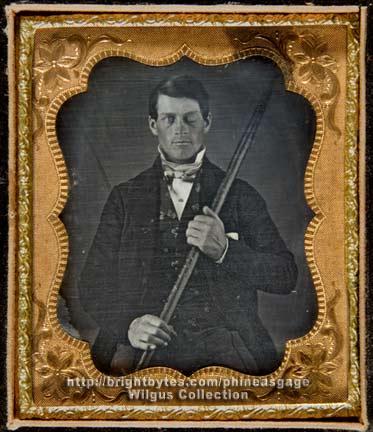
Phineas Gage news

(Photo via the collection of Jack and Beverly Wilgus)

This past Friday was the 150th anniversary of the death of one of psychology's all-time favorite subjects, Phineas Gage. Today in Vermont (as I learned via ScienceBlogs) the Cavendish Historical Society is holding a walking tour of famous sites related to Gage including the accident site itself, the home of Dr. Harlow (the surgeon who treated Gage) and the house that Gage was taken to after the accident.

The newsletter of the CHS published earlier this month gives some great historical background to Gage's accident, including this reference from the local newspaper on the following day:
Horrible Accident: As Phineas P. Gage, a foreman on the railroad in Cavendish, was yesterday engaged in tamping -for a blast, the powder exploded, carrying an iron instrument through his head an inch and a fourth in circumference, and three feet and eight inches in length, which he was using at the time. The iron centered on the side of his face, shattering the upper jaw and passing back of the left eye and out at the top of the head.

The most singular circumstance connected with this melancholy affair is that he was alive at two o’clock this afternoon, and in full possession of his reason, and free from pain. Ludlow Vt. Free Soil Union Sept. 14, 1848
Also this week was a post on Mind Hacks by Vaughan Bell who found a recent journal article with more details about Gage's life after the accident. Don't just settle for "Gage was no longer Gage"; as Malcolm Macmillan and Matthew L. Lena published in Neurophysiological Rehabilitation, Gage continued to work for the twelve years following the accident, seven of them as a driver in Chile, and at one point was examined by a doctor who found "no impairment whatever." The Mind Hacks post has been updated to include a link to the actual journal article as well.

P.S. Coming this summer: a post on the top ten subjects in psychology? I'm thinking Gage, Little Albert, the Bobo doll, Piaget's three kids, Lorenz' geese, Zimbardo's prisoner #819, etc. Who would you nominate?

-- posted by Steve