Wednesday, August 29, 2012

YOU figure it out!


I've been poking around in the "Problem-based Learning" literature for a writing project, and I mostly like what I see. The philosophy seems to be that good learning experiences can be inspired by presenting students with open-ended problems, and then helping them figure out pathways to possible solutions.

I ran into an interesting/exciting example on Twitter this morning: Casey Rutherford (@rutherfordcasey) posted a short slide show that he's using on his first day (note: the slide show uses SlideRocket to run, and I hope the link works for everyone).

Isn't that cool? Can you imagine walking into a class and seeing those four short slides, and then trying to tackle that problem all period?

I wonder if we could use this model in psychology classes, and I'd love to hear any examples you all know about. Here's my first attempt (for the memory unit)

- Slide one: The Memory Challenge
- Slide two: The goal: Figure out how many items you can memorize from a list, and decide what factors influence your ability to remember them.
- Slide three: Time frame: You have 25 minutes to do what you need to do to accomplish this task. Work with the group at your table.
- Slide four: GO

By tackling this challenge, students may uncover their own empirical data for "the magic number 7, plus or minus 2", serial position effect, chunking, mnemonic devices, massed/distributed learning, selective attention, and probably a bunch of other memory concepts that I can't even anticipate. What do you think? Does this kind of open-ended problem solving have a place in the psychology classroom?


posted by Rob McEntarffer

Monday, August 27, 2012

AP Psych Test Perfect Score - The "Rest of the Story"

Trevor Packer, a senior vice president at College Board, has been very active on Twitter over the summer. His posts about score distributions and inferences about difficulty, etc. of the AP tests have been fun/enlightening to read.

Last week, Trevor "tweeted" this message about the 1 student with a "perfect" score on the AP Psych exam. I was curious so I broke out my google research skills and, after a little digging, thought I found the AP Psych teacher at Spring-Ford high school in Pennsylvania. I found her email address and wrote to her, and she gave permission for me to share this anecdote on our blog.

So if you have time, say congrats to Susan Miscavage! She's not on twitter, so she was very excited to hear the news about one of her students (her exact quote was "I'm dancing around the living room right now.") She starts school today (5 sections of AP Psych!) and she will have a great (and hopefully motivational) story to her class.


posted by Rob McEntarffer

Tuesday, August 21, 2012

Cool poster to share


I'm a fan of the poster above known as the Holstee Manifesto. If you've never seen it or read it, take a moment to do so.

I saw it last year and thought, hey, I need to get one for my classroom. If you're like me, though, and money for classroom supplies is scarce, it may be that this poster's cost (between $32-$38) is too much for you, too.

So I wrote the company and asked if there was any way they could make their products available more cheaply for teachers. I exchanged e-mails with a couple of people there who were very nice and who wanted to do something, so they agreed to create a special discount of 25% for teachers. So here's the deal:
Send an e-mail to:    h e l p @ h o l s t e e . c o m (without the spaces, of course)
Be sure you sending the e-mail from your school e-mail account
Tell them that you want to order the poster (or posters) for your classroom, and ask for the educational discount
Feel free to tell them that you heard it about it from this blog if you want, but I don't get anything out of this - I'm just sharing something cool with our readers. It seems like a terrific company with good intentions, and I like that.


P.S. Yes, I love the great photo above as well. Yes, you could grab it and make your own prints, but you don't really want to do that, do you? Nah, I didn't think so! 


--posted by Steve

Monday, August 20, 2012

How and When to Show a TED Talk

This post - How and When to Show a TED Talk - emerged from a conversation on Twitter between myself and one of my favorite Tweeps, Eric Castro (eecastro), who teaches in California. Rarely a week goes by that I don't bookmark at least one item he passes along, and frequently I seem to read two or three links that he suggests a day.

As you'll see below, Eric mentioned using a TED Talk on day one, and, well, I'll let Eric take it from here (cross-posted from http://intellectualsprawl.blogspot.com/2012/08/how-and-when-to-show-ted-talk.html):

How and When to Show a TED Talk

I wouldn't say that we show a lot of TED Talks to our AP Psych students, but (a) Yosup and I do watch a lot of them for ourselves, and (b) we do show some to students.

Jon Ronson, who is a documentary filmaker and author, wrote The Psychopath Test: A journey through the madness industry, gave a TED Talk on his experiences with the question of sanity. Strange Answers to the Psychopath Test is 18-minutes long:


I would go so far as to say that this one video could serve as the introduction to our AP Psychology class. Either explicitly or implicitly, there is every single topic that we address in the course in this one video. But do I show it? And if so, when?

Part of me wants to lead off with this; use it as a teaser, use it as a draw. But, it's 18-minutes — an eternity for 17-year olds.

I mentioned this dilemma via Twitter, and you can see the dialogue that ensued between me and a Psych teacher in Durham, NC:


I'm not positive how I'll fit this into my 40-minute opening class, but I'm leaning toward teasing — just foreshadowing the questions and issues it raises — the video, asking students to take a position on the central question of the video ("Is there a definitive line that separates crazy from sane"), assigning students to watch the video for homework, and then having a discussion around the video during part of our next class (which will be an 80-minute period).

------------------
Thanks, Eric!
--posted by Steve

Sunday, August 19, 2012

How far will you go


Teaching operant conditioning just got a whole lot easier, thanks to this video (embedded above). The only problem I can see is that your students will want you to build them one.

(Apologies if I got this from you and didn't credit you - I got it somewhere in the past few weeks, saved it to my "watch later" queue on YouTube and just saw it.)

--posted by Steve

Saturday, August 18, 2012

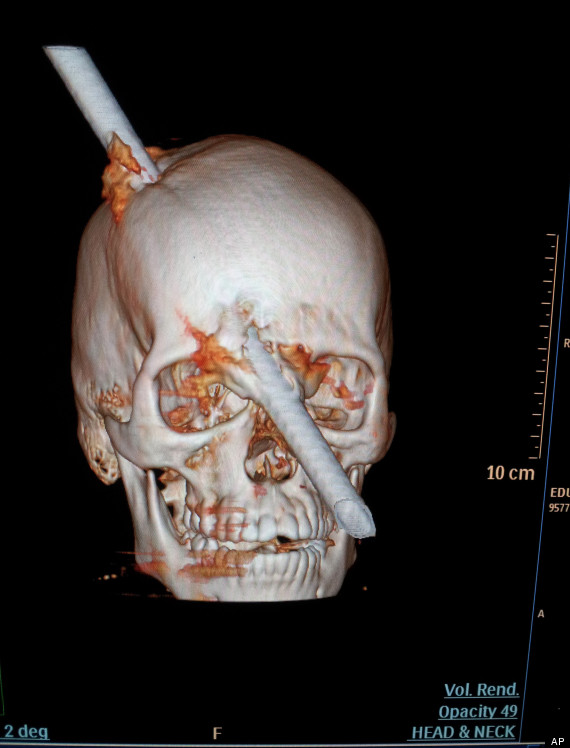
Another modern day Phineas Gage

Just spotted this item from Huffington Post shared by Stephen Chew on the PsychTeacher e-mail list: news of a 24 year old Brazilian construction worker who was impaled in his head by a 6-foot metal bar - and lived. I'm posting the photo below and video, but first wanted to highlight a couple of comments:
From the man's wife: "When he arrived [at the hospital] he told the doctors he wasn't feeling anything, no pain, nothing. It's unbelievable."
From the hospital's chief of staff, Luiz Alexandre Essinger: "[Essinger] said Leite was lucid and showed no negative consequences after the operation. 'Today, he continues well, with few complaints for a five-hour-long surgery,' Essinger said. 'He says he feels little pain.'"

Via Huffington Post
http://i.huffpost.com/gen/734833/thumbs/o-BRAZIL-WORKER-BAR-THROUGH-SKULL-570.jpg?4


If you cannot see the video embedded above, go to: http://www.youtube.com/watch?v=KN2mghDckDc


WOW.
--posted by Steve

Sunday, August 12, 2012

Summer connections

The service learning trip to Cambodia was full of great moments. Many can be related to psychology terms, text, and ideas.  For example:

The rice fields below is farmed by a widow, the mother of a cook at the orphanage we visited. The care and cultivation is more than she can manage, so about 20 came to help her in the rice process. The rice was in the stage where it needs to be thinned, thus it is pulled (with roots) out of the ground, dries for 2 days, then is replanted spaced further apart.

 First, we were there to help pull out, what we called "unplanting." Our Khmer friends gave us a demonstration, emphasizing the importance of keeping the roots attached for the replanting.
"Why, this doesn't look so hard!" we thought, slowly baking in the hot sun with mud oozing through our toes.  Seemed like some good observational learning would do the trick.

As you can see in this picture, things then shifted to shaping.  There were many successive approximations that were rewarded prior to the official process.

Below: sunrise at the child rescue center.

--posted by Nancy Diehl (via Steve)


Thursday, August 9, 2012

Psychat returns tonight

If you are on Twitter, please join a very informal group of fellow teachers tonight for a live chat (of sorts) called #psychat. Beginning tonight, we hope to have #psychat most Thursday nights during the school year from 8-9 pm ET.

If you're wondering WHAT THE HECK IS HE TALKING ABOUT, check out this post from January by #psychat co-host Heather Kilgallon (@irishteach) and an older post I did about the same topic.

Since it's the beginning of this academic year and many folks haven't started yet, I would like to hold off on the academic topics and talk about the ways that you get geared up for the new year. What gets you motivated? How do you set up your classroom for success? What policies or procedures help get your class off to the right foot? And best of all, how do you use psychological principles in your classroom?

I hope that you can join us tonight!

--posted by Steve (@highschoolpsych)
(who's back in the classroom and apologized for the dearth of recent postings from him!)

Wednesday, August 8, 2012

Computer/Presentation Remote Control

I recently did some research and purchased and am in love with a new tool for my class.  It is an RF remote (with a USB connecting device) that allows me to wander the room while still being able to control the computer.  The remote has a little mouse, but it is an incredibly useful tool for those of us who want to show multiple items on the screen as well as move around the room.  Below is a link for this wonderful little product.  It is plug-and-play with no software needed.  It works on both Macs and PCs and is the length of a 3x5 card at half the width.


posted by Chuck Schallhorn

Sunday, August 5, 2012

Looking for Some Review? Psych Courses Online

I begin next week with classes starting on August 13.  I know, it's really early.  On the off chance some are still on summer break and would like to do some review/look for some teaching insights for psych, I ran across this website that has condensed some online courses into on set of links.

The entire site list of courses is here:
http://www.openculture.com/freeonlinecourses

The Psychology Courses are here:
http://www.openculture.com/psychology_free_courses

Many of these link to courses existing on iTunes, others on YouTube and other sources.  Some are introduction courses, some are more upper level.  They seem like a good source for review and learning some deeper content.  In any case, they are definitely worth a look.


posted by Chuck Schallhorn