Wednesday, June 30, 2010

Guilty Except for Insanity


This is a new documentary about the Oregon State Hospital (made famous by One Flew Over the Cuckoo's Nest). It documents the struggles of 5 people in the hospital. It also touches on the history of mental hospitals and the legal struggles these patients face.

http://www.guiltyexcept.com/index.php

It was shown in Portland at the end of June and there is no word on when the full version will be available for the public, but there is contact information for the people involved in the documentary.

Here is little excerpt from the website:
"Guilty Except for Insanity follows the journeys of five people who enlist the insanity defense after being charged with serious crimes. The documentary portrays the circumstances surrounding their crimes and the dilemmas they confront as they enter the Oregon State Hospital under the "guilty except for insanity" plea."

-posted by Trevor Tusow

Poll Everywhere


This post comes to you from the Pacific Northwest! I (Rob) got to work with some FABULOUS teachers at the AP Psych Institute in Bellevue, WA, and we worked with an interesting website this morning: Poll Everywhere
http://www.polleverywhere.com/

This site allows you to post a multiple choice question for folks (students and/or teachers in a prof. development course, etc.) who can then text in a certain code and "vote" on one of the options. At our institute we used poll everywhere as part of a discussion about "Formative Diagnostic Items" - a formative assessment technique that helps teachers quickly gather data about student misconceptions.

(By the way: My participants are the BEST participants ever in the history of AP Psychology institutes. So there)

- posted by Rob McEntarffer

Thursday, June 17, 2010

Donors Choose projects for psychology teachers

DonorsChoose.org - Teachers ask. You choose. Students learn.

I was browsing DonorsChoose today and found several psychology-related projects to share. If you can, please consider helping these teachers help their students by contributing. If you are a teacher, DonorsChoose is a great way to get additional resources for your classroom. Go here if you are a teacher to find out how to begin the process. (Full disclosure: I did one last year to get copies of The United States Constitution: A Graphic Adaptation for my civics classes.)

Here are the projects I found:

--posted by Steve

Wednesday, June 9, 2010

Slogans and behavior - it's time for change

Okay, teachers, trust me on this one -- file it away for next year and bring it out when you want your students to apply their knowledge to a real-world setting.

The Wall Street Journal today posed a question: what's the best preventive health slogan for kids? The story focuses on Blue Cross Blue Shield's new "5-2-1-0" campaign (PDFs in English and in Spanish) to teach healthy habits and reduce the amount of obesity and prevalence of diabetes by encouraging children to do the following everyday:
  • 5 servings of fruits and vegetables a day
  • 2 hours or fewer of screen time
  • 1 hour of physical activity
  • 0 unsweetened drinks
As Katherine Hobson implies in the WSJ, though, "5-2-1-0" is not terribly catchy, and public service campaigns in general aren't as popular as slogans produced by the private sector in large part due to the vast differences in advertising budgets. She states that with rare exception, slogans like "Just Say No to Drugs" aren't as memorable as "Coke is it."

So here's your assignment, in three parts:
1) Have your students redesign the 5-2-1-0 campaign using what they have learned in psychology. This would be a perfect time to include subjects like operant and classical conditioning, memory, motivation, persuasion, etc. Can they create something that would be more memorable and most importantly that would lead to behavior change? (And how could you measure whether it was successful?)

2) See if your students can counter Hobson's article. For every "Coke is it" there are surely many other private sector ad campaigns that fall flat, and maybe there are more catchy public service slogans out there than she points out. "Fried Egg," also known as "This is Your Brain on Drugs," for example, was a PSA created by the Partnership for a Drug-Free America. "Friends Don't Let Friends Drive Drunk" is another memorable PSA. How many others can they think of?

3) How effective are PSAs in general at changing behavior? Have your students identify an issue, find the slogans used to encourage behavior change and then look for evidence that the behavior actually changed during the time that the slogan was used. Did "Just Say No" or "Fried Egg" really change behavior? Help them find the evidence that would support or reject these claims.

--posted by Steve

Sunday, May 23, 2010

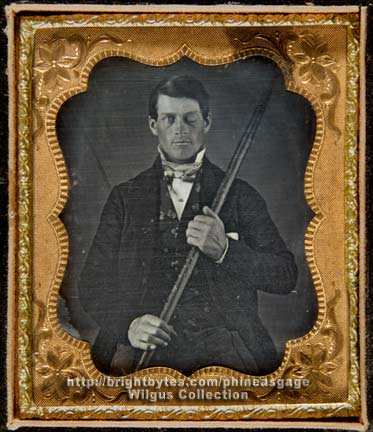
Phineas Gage news

(Photo via the collection of Jack and Beverly Wilgus)

This past Friday was the 150th anniversary of the death of one of psychology's all-time favorite subjects, Phineas Gage. Today in Vermont (as I learned via ScienceBlogs) the Cavendish Historical Society is holding a walking tour of famous sites related to Gage including the accident site itself, the home of Dr. Harlow (the surgeon who treated Gage) and the house that Gage was taken to after the accident.

The newsletter of the CHS published earlier this month gives some great historical background to Gage's accident, including this reference from the local newspaper on the following day:
Horrible Accident: As Phineas P. Gage, a foreman on the railroad in Cavendish, was yesterday engaged in tamping -for a blast, the powder exploded, carrying an iron instrument through his head an inch and a fourth in circumference, and three feet and eight inches in length, which he was using at the time. The iron centered on the side of his face, shattering the upper jaw and passing back of the left eye and out at the top of the head.

The most singular circumstance connected with this melancholy affair is that he was alive at two o’clock this afternoon, and in full possession of his reason, and free from pain. Ludlow Vt. Free Soil Union Sept. 14, 1848
Also this week was a post on Mind Hacks by Vaughan Bell who found a recent journal article with more details about Gage's life after the accident. Don't just settle for "Gage was no longer Gage"; as Malcolm Macmillan and Matthew L. Lena published in Neurophysiological Rehabilitation, Gage continued to work for the twelve years following the accident, seven of them as a driver in Chile, and at one point was examined by a doctor who found "no impairment whatever." The Mind Hacks post has been updated to include a link to the actual journal article as well.

P.S. Coming this summer: a post on the top ten subjects in psychology? I'm thinking Gage, Little Albert, the Bobo doll, Piaget's three kids, Lorenz' geese, Zimbardo's prisoner #819, etc. Who would you nominate?

-- posted by Steve

Thursday, May 20, 2010

Self-Discipline more Important for Success than IQ


These findings probably won't surprise most teachers, but I wonder if the findings might start interesting classroom conversations. This LifeHacker blog post summarizes research coming out of Seligman's Positive Psychology Center regarding the relative impact of high levels of self-discipline vs. IQ as predictors of success. As teachers, I bet we would have predicted the outcome: Self-discipline wins. But it might be interesting to hear what students would predict, and whether these findings match their experiences/perceptions? The original research article is also available in full text.

It also might be interesting to bring Dweck's research about "ability vs. effort" attributions into this conversation about self-discipline vs. intellectual "ability"


Posted by Rob McEntarffer

Wednesday, May 19, 2010

Psychology Position in Clintonville, WI

A full-time teaching position for the 2010-2011 school year has opened up at Clintonville High School in Clintonville, WI (35 miles west and slightly north of Green Bay). The assignment includes: AP Psychology, Sociology, World Studies and US History.

Full details of the job can be found at
http://ww2.wisconsin.gov/state/employment/app?COMMAND=gov.wi.state.cpp.job.command.ShowJobDetails&selectedJob=201005121339521476804 Applications must be sent by May 28th.

If you have information on a high school teaching position which includes psychology that we can post on the THSP Blog, please contact Kent Korek at kkorek@germantown.k12.wi.us. Best of luck to everyone looking for an opening.

Tuesday, May 18, 2010

News from TOPSS

Below is the latest news from Emily Leary (Eleary@apa.org) regarding the Teachers of Psychology in Secondary Schools (TOPSS).

2010 TOPSS Committee Elections

The mission of the APA Committee of Teachers of Psychology in Secondary Schools (TOPSS) is to promote the scientific nature of introductory and advanced high school psychology; to meet curricular needs of secondary school teachers; and to provide opportunities for high school students to be recognized and rewarded for their academic excellence. If you would like to become more involved in TOPSS, we encourage you to consider serving on the TOPSS Committee. TOPSS is especially interested in encouraging individuals from diverse backgrounds (including diversity in race/ethnicity, gender, ability/disability, sexual orientation, age, and religion) to consider running for TOPSS Office. In 2010, the following three elected positions will be filled:

  • Chair-Elect
  • Member-at-Large (2)

The Chair position is a three-year position and the Member-at-Large positions are each two-year positions. Please consider nominating a colleague who would make a positive impact. We encourage teachers to consider volunteering to be a candidate for the TOPSS Election Ballot. Nomination materials should be submitted by July 1, 2010. For more information, visit http://www.apa.org/ed/precollege/topss/call-for-nominations.aspx.

2010 APA TOPSS Excellence in Teaching Award Recipients

The TOPSS Committee congratulates William James of Milford High School (Highland, MI) and Scott Reed of Hamilton High School (Chandler, AZ) for being selected as recipients of the 2010 APA TOPSS Excellence in Teaching Awards. The TOPSS Teaching Awards recognize outstanding teachers in psychology. The award recipients will receive a framed certificate, award, cash prize of $300, ActivePsych CD series, and a free TOPSS membership or renewal for the 2011 membership year. The ActivePsych CD series has been generously donated by Worth Publishers. Congratulations, Bill and Scott!

2010 APA TOPSS Scholars Essay Competition Winners

The TOPSS Committee congratulates the student winners of the 2010 APA TOPSS Essay Competition. Sabina Babar of Colonia High School (Colonia, New Jersey), Rachael J. Erickson of Sutton Memorial High School (Sutton, Massachusetts), Allison Gutworth of Colonia High School (Colonia, New Jersey), and Alexis Suskey of Grandville High School (Wyoming, Michigan) each received $250 scholarships for their winning essays. The 2010 essay question asked students to focus on the effects human behavior has had on the current environmental crisis.

Information about the 2011 APA TOPSS Excellence in Teaching Awards and the 2011 APA TOPSS Scholars Essay Competition will be announced during the fall of 2010.


Posted by Kent

Teaching Positions

As many of you are painfully aware, there are a large number of school districts across the country laying off staff. In some places hundreds of teachers are being given pink slips.

We here at the Teaching High School Psychology Blog would like to do what we can to help connect teachers with job openings. If anyone is aware of a teaching posting which includes psychology as part of the assignment, please send the information to Kent Korek at kkorek@germantown.k12.wi.us. I will then post the information on the THSP blog.

AP Psychology Free Response Questions

***This post has been updated to include questions through 2014.
Go to this link: 
http://teachinghighschoolpsychology.blogspot.com/2015/01/ap-free-response-questions-updated-to.html#sthash.BztY8uDx.dpbs


In the AP Courses and Exams section of the AP Central website (http://apcentral.collegeboard.com/apc/Controller.jpf), you will find all of the AP Psychology Free Response Questions since 1999 along with various other documents pertaining to the FRQs. Many people have difficulties finding the documents from 1999-2002 as they are on a different web page. To make it easier for teachers, below you will find links to the AP Central documents. Please report any faulty links to Kent Korek at kkorek@germantown.k12.wi.us

2010

Free Response Questions 1 & 2
FRQ Scoring Guidelines (Rubrics)
Student Performance Q&A
FRQ Scoring Statistics
Sample Response Question 1
Sample Response Question 2
Overall Grade Distribution


2009

Free Response Questions 1 & 2
FRQ Scoring Guidelines (Rubrics)
Student Performance Q&A
FRQ Scoring Statistics
Sample Response Question 1
Sample Response Question 2
Overall Grade Distribution


2008

Free Response Questions 1 & 2
FRQ Scoring Guidelines (Rubrics)
Student Performance Q&A
FRQ Scoring Statistics
Sample Response Question 1
Sample Response Question 2
Overall Grade Distribution


2007

Free Response Questions 1 & 2
FRQ Scoring Guidelines (Rubrics)
Student Performance Q&A
FRQ Scoring Statistics
Sample Response Question 1
Sample Response Question 2
Overall Grade Distribution


2006

Free Response Questions 1 & 2
FRQ Scoring Guidelines (Rubrics)
Student Performance Q&A
FRQ Scoring Statistics
Sample Response Question 1
Sample Response Question 2
Overall Grade Distribution


2005

Free Response Questions 1 & 2
FRQ Scoring Guidelines (Rubrics)
Student Performance Q&A
FRQ Scoring Statistics
Sample Response Questions
Scoring Commentary on Sample Response Questions
Overall Grade Distribution


2004

Free Response Questions 1 & 2
FRQ Scoring Guidelines (Rubrics)
Student Performance Q&A
FRQ Scoring Statistics
Sample Response Question 1
Sample Response Question 2
Scoring Commentary on Sample Response Questions
Overall Grade Distribution


2003

Free Response Questions 1 & 2
FRQ Scoring Guidelines (Rubrics)
Student Performance Q&A
FRQ Scoring Statistics
Sample Response Question 1
Sample Response Question 2

Scoring Commentary on Sample Response Questions
Overall Grade Distribution


2002

Free Response Questions 1 & 2
FRQ Scoring Guidelines (Rubrics)
Student Performance Q&A
FRQ Scoring Statistics
Sample Response Question 1
Sample Response Question 2
Scoring Commentary on Sample Response Questions
Overall Grade Distribution


2001

Free Response Questions 1 & 2
FRQ Scoring Guidelines (Rubrics)
Student Performance Q&A
Sample Response Question 1
Sample Response Question 2
Scoring Commentary on Sample Response Questions

2000

Free Response Questions 1 & 2
FRQ Scoring Guidelines (Rubrics)
Sample Response Question 1
Sample Response Question 2

1999

Free Response Questions 1 & 2
FRQ Scoring Guidelines (Rubrics)
Sample Response Question 1
Sample Response Question 2
Scoring Commentary on Sample Response Questions