Monday, September 21, 2009

Superheroes Brain Assignment

Scott Olson from Towson High School, Towson, MD, has developed a fantastic brain project centered around superheroes. Scott graciously gave us permission to post his activity on the THSP Blog.

Superheroes

Science fiction writers are always searching for good ideas for plots that will capture the interest of their readers. A common premise was that radiation somehow altered biological processes, transforming normal human beings into superhumans, some good and some evil. One example is the Incredible Hulk.

Your task is to create your own superhero by pretending that it is possible to magnify the abilities governed in selective sites in the human brain. You may find it helpful to begin by listing the component parts of the brain and their functions. Identify the area of the brain that would have to be altered to accomplish skills you've determined are important for your character. You must choose nine (9) of these components to include in your superhero. Some of these components will be necessary to accommodate the characters new skills while some will be the ones altered to produce the new characteristics.

You will need to:
. Draw your superhero, (can use clip art) (10 points)
. Design a costume/outfit that reflects his/her main ability (20 points)
. Name your character (10 points)
. Determine the super abilities she/he possess (20 points)
. Identify the brain structures that will need to be augmented to accommodate the new super skill (30 points)
. Identify a simple plot that would encourage this superhero to come to the rescue (10 points)
Thanks to Scott for sharing your idea with our blog readers. For a Word Document version of this activity go to http://www.4shared.com/dir/10555367/29577282/sharing.html

2009 AP Psychology Exam Score Distribution

The score distribution and sample FRQ responses for the 2009 AP Psychology Exam have been posted at AP Central. More than 150,00 students took the exam with over 100,000 receiving a score of 3 or higher.

For the complete distribution of scores go to AP Central at http://apcentral.collegeboard.com/apc/members/exam/exam_questions/2088.html You can also find sample student responses to the two FRQs.

I assume the Scoring Statistics and Student Performance Q&A (the report from the Chief Reader) will be coming at a later date. We will let you know as soon as they are posted.

Visual Cognition Lab - Change and Inattentional Blindness

The Visual Cognition Lab at the University of Illinois have developed a number of short video clips demonstrating Change Blindness and Inattentional Blindness. The videos include the "woman with the umbrella" as well as the infamous "gorilla in front of the elevator".

The clips can be purchased at http://www.viscog.com/ (make sure to take advantage of the special prices for teachers), or streamed off the internet at http://viscog.beckman.illinois.edu/djs_lab/demos.html

As stated in the directions, it is important teachers stress to their students the need to count the number of passes the players make prior to showing the video.

The British "Awareness Test" advertisement http://www.break.com/index/awareness-test.html puts inattentional blindness to work.

Sunday, September 20, 2009

KTOPSS 15th Annual State Convention

The Kansas Teachers of Psychology in Secondary Schools (KTOPSS) will be holding their 15th Annual State Convention on Monday October 5, 2009 at Emporia State University in Emporia, Kansas. Anyone within driving distance of Emporia State is welcome to come. You do not need to teach in Kansas to attend. The convention details are below.

Kansas Teachers of Psychology in Secondary Schools (KTOPSS) 15th Annual State Convention
Monday, October 5, 2009, 9:00 am to 4:00 pm
Jones Conference Center, Visser Hall 330
Emporia State University, Emporia, Kansas
Registration Cost: $30 (lunch provided)
Contact: Stefanie Forbes stefanieforbes@SMSD.ORG


Agenda
8:00 to 9:00 Registration, Flea Market, and Psychology Displays

9:00 to 9:10 Welcome
Stefanie Forbes, KTOPSS Coordinator, Shawnee Mission Northwest High School

9:10 to 10:10 Keynote Address
Laura Brandt, Adlai Stevenson High School, Chicago, IL, Past Chair of TOPSS
Three Pounds: Research, Activities, and Resources for Teaching about the Brain

10:10 to 10:30 Break

10:30 to 11:30 Teaching the Biopsychological Methods Domain of the National Standards for High School Psychology Curricula Moderated by Stefanie Forbes, KTOPSS Coordinator, Shawnee Mission Northwest High School

11:30 to 1:00 KTOPSS Business Meeting and Lunch (provided)
Stefanie Forbes, KTOPSS Coordinator Shawnee Mission Northwest High School, presiding

1:00 to 2:00 Invited Address
Kent Korek, Germantown High School, Germantown, WI, Moderator of Teaching High School Psychology blog and faculty member for the College Board’s AP Summer Institute
Using Technology to Teach Psychology

2:00 to 3:00 Psych Sprints
Demonstrations and activities to promote quality teaching and learning of psychology

3:00 to 4:00 Teaching Material Distribution to Workshop Attendees and Workshop Evaluation


**Funding for the 15th KTOPSS Convention is generously provided by the Board of Educational Affairs through the American Psychological Association’s Education Directorate.


KTOPSS is endorsed by Teachers of Psychology in Secondary Schools. The Executive Committee of the Society for the Teaching of Psychology (Division 2 of the APA) views the convention as a worthwhile activity and encourages high school teachers to attend.

For more information on the KTOPSS State Convention, contact Stefanie Forbes at stefanieforbes@SMSD.ORG

TV alert: House season premiere


I'm guessing most of you who would be interested in this sort of thing already know this, but just a reminder that this Monday night's House is the two-hour season premiere. When we last left Dr. House he was checking into a mental hospital and that's the setting for the first episode.

Several scenes from the preview call to mind Jack Nicholson's performance in "One Flew Over the Cuckoo's Nest" -- the knit cap, the basketball scene, being dragged away by aides and the "you guys are crazy" statement. I didn't see the Chief or Martini in the House preview, though, and it looks like one of my all-time faves Andre Braugher is taking a turn as the severe administrator (darned, no Nurse Ratched!).

I'd be interested to hear your thoughts in the comments below after the episode as well as what your students say if you have time for a class discussion. We can complain all we want about getting "the truth" out about psychology but for better or worse an episode of House will have a lot more viewers and influence.

The DNA of Picky Eaters

The July 21st episode of Nova ScienceNOW included a segment on taste entitled "The Science of Picky Eaters" which detailed how children may be predisposed to like or not like certain foods. The segment goes into detail regarding the basics of taste and how DNA may influence one's taste preferences.

The 12:45 segment can be played or purchased from the show's website at http://www.pbs.org/wgbh/nova/sciencenow/0404/01.html The website also includes a teacher's guide for the show with a classroom activity involving PTC paper, a complete transcript of the segment, audio interactive segments, additional video clips and a FAQ page.

A special thanks to Russell Hoffman, Psy.D., School Psychologist at SAR High School in the Bronx, NY whose initial message on the AP Psychology Electronic Discussion Group provided the impetus behind this posting.

Saturday, September 19, 2009

Psychology Misconceptions Test

Over the course of this past summer, some of you may have had to opportunity to read a fantastic article on common misconceptions many students tend to have when they enter an Introductory Psychology course. (The Effect of Refuting Misconceptions in the Introductory Psychology Class by Patricia Kowalski and Annette Kujawski Taylor of the University of San Diego in the July-September 2009 issue of the Teaching of Psychology Journal.)

As part of their study Dr. Kowalski and Dr. Kujawski-Taylor develop a 100+ question test of misconceptions. I asked Dr. Annette Kujawski Taylor if I could share her test with high school teachers across the country. She graciously agreed and detailed a number of points to consider regarding the test. Rather than explain her points, I've included her email below.
Hi Kent:

The attachment looks great--by all means, share it. You went to a lot of trouble. One thing we often ask students is how confident they are in their belief. What we find is that the higher the confidence the lower the accuracy tends to be; of course this varies somewhat across items. Anyway, the point is that the stronger a misconception is held, the harder it is to change to a correct conception.

Also, I would suggest in the blog to just pick a subset of items! Students get bored with too many items ;) Also, some teachers just might not be prepared to provide evidence for some of the items and it might turn out to be a nightmare! I would direct students to the neuroscience for kids website for lots of good answers, and the new book by Scott Lilienfeld should be a great resource as well. I actually got quite a few of these by trading back and forth with Scott.

Finally, some items are a bit 'iffy' such as the one about the blanket statement that people who use heroin become addicted to it. Turns out that, just like with cocaine, there are a lot of casual users, and it is not a given that one will become addicted; however, the possibility is always there but more importantly for you, the evidence is harder to produce in class. So items that are iffy are more difficult, especially with younger adults who are not yet at Piaget's highest stages of cognitive development and might not see the shades of gray quite as well--when I say preponderance of the evidence sometimes I might be looking at a shade of gray that's just a bit darker than midway.

Annette


Annette Kujawski Taylor, Ph.D.
Professor of Psychology
University of San Diego

You can get your PDF copy of the test by going to the 4Shared File Sharing Account at http://www.4shared.com/dir/10555367/29577282/sharing.html
or go to the Google Documents page at http://docs.google.com/fileview?id=0B6RUrPtjJsQiNTJkZDI5YWUtYWEyOC00NmQ0LTg2MTktYTdhMTBmMGYyMjg2&hl=en

A special thanks to Dr. Annette Kujawski Taylor for her willingness to share the Misconceptions Test. Our hope is that in time, she and other introductory psychology college teachers will see less and less students having these misconceptions due to them being refuted at the high school level.

Friday, September 18, 2009

Newborn perception


I know, I know, about every other blog post from me is from the podcast "Radio Lab", but I just can't resist: one of their latest shows, "After Birth", covers (among other topics) newborn human perception. Most of the podcast is devoted to an interview with Charles Fernyhough, developmental psychologist and author of the very cool-looking book "A Thousand Days of Wonder". Some of the newer research findings blew me away! Examples:
  • The lens in our eyes gradually yellows as we age, so babies probably see much more vivid blues and greens than we do
  • When infants see simple visual stimuli, neurons in their visual cortex fire as expected, but neruons in their auditory cortex ALSO FIRE! They are possibly "hearing" visual images? So we're born with a form of "synaesthesia" but we grow out of it? Wowza!

Additive Color Vision Simulation

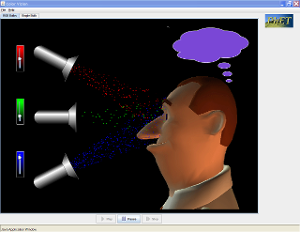
The University of Colorado at Boulder had developed a number of interactive simulations. Unfortunately, all but one are geared more towards science and math classes rather than psychology. The one psychological simulation involves color vision which does a fantastic job of demonstrating the trichromatic color theory as well as the concepts of additive color.

Users can adjust the intensity of red, green and blue colored lights to see the effects on the subjects vision.

All of the simulations require the use Java 1.5 which can be downloaded for free from a link on site. To find the vision color simulation, simply go to http://phet.colorado.edu/simulations/sims.php?sim=Color_Vision#topics.

Thursday, September 17, 2009

Simulations of Vision Loss

Within the Ohio Lions Eye Research Foundation's (OLERF) website a page is devoted to various types of vision loss. The site tries to describe and simulate what each impairment would be like both visually and textually. A complete list, with hyperlinks, of each vision loss difficulty included on the site is listed below or you can go to http://www.ohiolionseyeresearch.com/simulati.htm#Normal%20View for the complete listing.