Sunday, October 10, 2010

Hal Herzog responds to THSP readers

In September I posted an alert to THSP readers about Dr. Hal Herzog's new book Some We Love, Some Hate, Some We Eat. Readers were invited to post their questions to Hal and he agreed to answer them in a follow-up post. We only had three queries posted, so Hal was kind enough to address each one individually and they are posted below. Also, the free copy of his new book (generously arranged by Rachel Elinsky of HarperCollins) was awarded by random drawing to commenter Virginia Welle who teaches in Wisconsin.

Here are the posted questions, followed by Dr. Herzog's responses and a special note to high school psychology teachers at the end:

Dr. Herzog,
Animal research is something that fascinates and sometimes sparks ire among my students. The title of your book implies that you've got some insight as to why we feel so passionately about the treatment of some animals (e.g. pets), but not others (e.g. cockroaches). What can I tell my students about this seeming inconsistency? -- Mrs. Welle

Dear Mrs. Welle,
The reason that we care so much for some animals and so little about others is a matter of both nature and nurture. First the nature part. Ethologists such as Konrad Lorenz argued decades ago that humans find some animal cute because they have facial characteristics that bring out our parental instincts. Puppies, kittens and baby seals and Mickey Mouse are irresistible because they have big eyes, disproportionately large heads, and soft features. On the other hand, there is good evidence that our fear of snakes is an evolutionary relic passed down from our Stone Age ancestors.
However, culture can override our biological impulses. A cute puppy which an American would find adorable is seen as a tasty dinner entrĂ©e in parts of Asia. And if you live in Sri Lanka whether you have a pet dog is almost completely determined by your religion: fewer than 5% of Muslim homes contain a pet dog compared to over 90% of Buddhist homes! That’s were nurture comes in.

Shana said...
This topic is great and I can't wait to read the book. I own a ferret and just recently got a puppy. My in-laws love the dog, but try to keep as far away from the ferret as humanly possible. I find myself identifying with the topic, and I wonder to what extent these preferences and aversions are affected by experiences and to what extent they are affected by biological predispositions.

Shana – See my response to Mrs. Welle’s above. It addresses the question of biological dispositions. However, it is also true that different people have different likes and dislikes in animals. For example, while most people hate snakes because of a biological predisposition, I have always been attracted to them. I collected snakes when I was a kid, and I also conducted a lot of snake behavior research in the early part of my career. By the way, most people with snake aversions have never had a traumatic experience with snakes, and studies by Gordon Burghardt at the University of Tennessee indicate that this is also true Japanese monkeys who are snake phobic.
One thing that determines what type of animals people like is how they were brought up. Children raised with dogs tend to become “dog people” when they are adults and vice versa with “cat people.” Some studies have shown that there are personality differences in “dog people” and “cat people.” Cat people tend to be a bit more neurotic but also more open to new experiences. However, these differences tend to be fairly small.

Anonymous said ...


I have had my cats for about six years. I understand the attachment to them more than other cats, but here is something I do not understand--why do I care about my cats more than other humans.

This is a tough question as I don’t really know your situation, but here is what we do know about attachment to pets. First, people living alone are more likely to be highly attached to their companion animals. This is interesting because people living with children at home are (a) more likely to have a pet living in their house, but (b) are less likely to be highly attached to their pet. This suggests that for some people, pets are, indeed, child substitutes. This was certainly true of my wife and I before we had kids. We absolutely doted on Molly, our wonderful black Lab.
Second, while some people argue that “animal people” tend not to like other people, in my experience, this is usually not the case. In fact, studies consistently show that people who are empathetic toward animals also show more empathy towards other people. (You will not be surprised to learn that women are generally more empathetic than men and are also more concerned about the protection and well-being of animals.)

Message to high school psychology teachers from Hal.

I think that we can learn a lot about human nature by studying the psychology of our relationships with other species. These include big issues like the nature-nurture issue, how we make moral judgments, and why human thinking is so often illogical. While these themes run through my book, the material most relevant to psychology teachers is in Chapter 2 (The Importance of Being Cute: Why We Think What We Think About Creatures That Don’t Think About Us), Chapter 3 (Pet-O-Philia: Why Do Humans (And Only Humans) Love Pets), and Chapter 10 (The Carnivorous Yahoo Within Ourselves: Dealing With Moral Inconsistency).
In addition, you might want to check out Animals and Us, the blog on human-animal interactions that I write for Psychology Today.


-- posted by Steve

Thursday, October 7, 2010

Cengage Learning Webinar Series

Cengage Learning is sponsoring a number of Webinars for high school psychology teachers. The series highlights Stephen Franzoi of Marquette University and Kristin Whitlock of Viewmont High School, Bountiful, UT. Below you will find information on each Webinar session.

Title: Psychology: Promoting Critical Thinking While Linking to the National Standards

Description: This workshop will help high school teachers link the use of the American Psychological Association's National Standards for High School Psychology Curricula in their courses to critical thinking exercises easily implemented into their curriculum. After a review of the structure of the National Standards, specific exercises will be presented.

Presenter: Kristin Whitlock, Psychology Teacher and Chair of the Working Group for the Revised High School Psychology Standards

Date/Time: October 19, 2010: 3:00 pm Eastern/12:00 pm Pacific Register now.
Date/Time: November 17, 2010: 6:00 pm Eastern/3:00 pm Pacific
Register now.


Title: Psychology: Encouraging Students to Identify With Course Material Through Self-Discovery Exercises

Description: Psychology, as a science and as a high school course, is a journey of discovery undertaken by both researchers and students. By regularly encouraging students to consider how psychological knowledge relates to their own lives, you place their learning experience within a personally relevant context that enhances learning of course material, while also fostering self-insights that can be applied to their daily living. Learn how Stephen Franzoi, author of Psychology: A Discovery Experience, facilitates this personal journey of discovery in his psychology classes and in his psychology textbooks.

Presenter: Stephen Franzoi, Author

Date/Time: October 26, 2010: 3:00 pm Eastern/12:00 pm Pacific Register now.
Date/Time: October 26, 2010: 6:00 pm Eastern/3:00 pm Pacific
Register now.


Title: Psychology: How Do People Think and Behave Differently in Individualist and Collectivist Cultures?

Description: Two belief systems that are important to understanding the psychology of human behavior are individualism and collectivism. This webinar will discuss how the psychology of people from different cultures differs due to their individualist-collectivist bents and how this understanding will enrich your students' learning.

Presenter: Stephen Franzoi, Author

Date/Time: December 9, 2010: 4:00 pm Eastern/1:00 pm Pacific Register now.

These webinars will be conducted via conference call and WebEx. In order to participate, you must have an Internet connection and a separate phone line. Posted by Kent Korek.

Tuesday, October 5, 2010

TOPSS Membership Drive

The following is from Kimberly Patterson, the Membership Coordinator for Teachers of Psychology in Secondary Schools (TOPSS).


The APA Affiliate for Teachers of Psychology in Secondary Schools!

Fall Blitz!
TOPSS Membership for High School Teachers!


It is the prime time to grow membership with members being able to join and get 16 months for the price of one year! Please refer potential members to http://www.apa.org/membership/hs-teacher/index.aspx. This link of the TOPSS website also have all the information for new members, including Benefits and Services, Discounts, Dues and Eligibility.

Curriculum Support:
  • Unit Lesson Plans
  • Powerpoints
  • Online Psychology Laboratory (OPL)
  • Posters in the classroom
  • National Standards for HS Psychology Curricula!
Recognition for Teachers and Students:
  • Excellence in Teaching Awards
  • APA/TOPSS Essay Competition
  • Outstanding Achievement in Psychology Certificates
Support:
  • Psychology Teacher Network (PTN) Quarterly Newsletter
  • Science Fair/Psychology Fair help
  • Mentor Program
  • Minority Recruitment Program
  • Speakers Bureau
  • Professional Development/Clark Workshop
If you have any questions, please contact Kimberly Patterson at kimberly.c.patterson@browardschools.com. If you need a hard copy membership form, please contact Emily Leary at ELeary@apa.org. We want to help through promoting High School Psychology and provide assistance for teachers with materials that are subject specific.

Sunday, October 3, 2010

Great pictures via Wellcome Images


Fingers on the brain - Close up photograph of the gyri and sulci of a human brain overlayed with an image of the artists fingers.


A tweet by neuroscientist turned writer Mo Constandi (@mocost) drew my attention to Wellcome Images, an amazing collection of historical illustrations and modern medical images that are available to be used in classrooms for free as part of a Creative Commons license. I'll post a few images here, but believe me when I say there are hundreds of others that are amazing.    -- posted by Steve

Neurons in the brain - illustration
 
Hair cell of inner ear, via electron microscope

The gyri of the thinker's brain as a maze of choices in biomedical ethics.

 The Brain: The Cerebral Cortex (1537)

Tissue from the thalamus stained with antibodies to receptors for orexin (stained red).
Orexins are peptide hormones that help keep us awake and alert, and may also stimulate the appetite.

Wednesday, September 29, 2010

Zimbardo cancels NCSS appearance - but vows to be there next year

I was disappointed to learn from Daria Schaffeld yesterday that one of the favorite psychologists of high school psychology teachers everywhere - the one and only Dr. Philip Zimbardo - would be unable to attend the National Council for the Social Studies conference in Denver in November. I was unable to attend the conference but on behalf of saddened HSPTs I contacted Dr. Z. to ask for more information on the cancellation.

First, the cancellation has nothing to do with any lack on enthusiasm for social studies or psychology, as Dr. Zimbardo indicated that he "has already committed to next year in DC" where the conference will be held in December 2011. The conflict has to do with the success of his new project, Heroic Imagination, which is described on its website as the realization of Dr. Philip Zimbardo's vision for an organization dedicated to creating a global community of heroes through education, research, media, and public engagement campaigns." Dr Z. will be in Mexico in November at a conference celebrating innovations in humanity where he "won their prize last year for [his] lecture on creating every day heroes." As part of that award, 50 high school students were given awards to attend the conference with Dr. Zimbardo on what he described as "establishing eco-hero projects in their schools."

What ultimately led to his withdrawal from the NCSS conference was a lack of flexibility in getting travel accommodations from Mexico to Denver. Under perfect conditions he could only get from one place to the other with minutes to spare, and given the amount of air traffic delays and cancellations these days, he knew the chances were slim of getting to the NCSS conference in time and he would most likely have had to pull out with virtually no notice with any delay.

But cheer up! First, Dr. Z. is working to make the world a better place, so who can argue with that? Second, he's committed to DC next year. And third, as Daria noted, there are already some amazing psychology sessions lined up in Denver, including these on Friday and Saturday. I look forward to hearing reports in November - please e-mail me (Steve) with your experiences! 


Psychology: Vistas, Visions, Voices, and Vital Active Learning Demonstrations with psychology teacher rock-stars Charlie Blair-Broeker (IA) and Randy Ernst (NE)

Teaching Psychology as a Journey of Discovery Using Self-Report Questionnaires with Stephen Franzoi of Marquette University

Mile-High Psychology with teachers Daria Schaffeld and Joe Geiger (IL)

Visions and Voices on Television: Making Psychology Concepts Come Alive with teacher Patricia Baima (IL) and Cynthia Prehar of Framingham State University

Classroom Motivation Knowledge and Skills for the 21st Century with Lee Morganett of Indiana University Southeast


Cross-Curricular Lesson Planning and Psychology: Reaching a 21st Century Learner with teacher Sean Tischler (DE)

A Voice from the Past—A Vision for Hope with Ted Englemann (lecturer, photographer, educator, and veteran of the war in Vietnam)

Creating and Supporting an AP Learning Community for All Students with Sabrina Ehmke, Matthew Walsh, and David Allen (IL)

Teaching Happiness, Building Global Citizens with Ellie Ford and Abigail Konopasky, Project Happiness

Tuesday, September 28, 2010

Sim Daltonism - Color Blindness Simulation


The name of this program is a complete mystery to me, but its a VERY slick little color blindness simulation program. Many websites provide still pictures (or videos) that try to show the impact of color blindness, but this program simulates color blindness with anything on your screen (with adjustments for different kinds of color blindness). Might also be useful to some student research projects investigating the impact of color changes on perception of still images, videos, etc.?

Sim Daltonism download site: http://michelf.com/projects/sim-daltonism/

posted by Rob McEntarffer

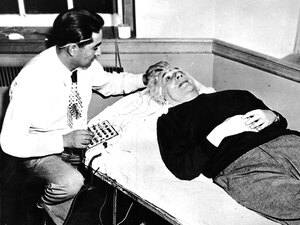
Einstein's Brain

This last June (2010), National Public Radio did a report on the whereabouts of Einstein's Brain. The story details, believe it or not, the travels of the brain since Einstein's death over fifty years ago. On many levels, the history of the brain is both interesting and a bit sad that the brain of whom many believe to be the most intelligent person of the twentieth century, was not studied for its secrets but sat in a jar on a shelf.

To hear the broadcast from June or read a transcript of the report, go to http://www.npr.org/templates/story/story.php?storyId=126229305

A special thanks to Corey Kirsch, Waukesha South High School, Waukesha, WI for sending this link to the Teaching High School Psychology Blog. If you have ideas for a posting, please send them to kkorek@germantown.k12.wi.us

Monday, September 27, 2010

2010 CHI-TOPSS Conference - October 22nd

Below is an invitation to the Chicago Teachers of Psychology in Secondary Schools (CHI-TOPPS) annual conference from Bobbi Pehle and Matt Bowden of the Lincoln-Way School District in New Lenox, IL . Anyone within driving distance of the Chicago area is encouraged to attend.

Dear Psychology Teacher,

We are looking forward to seeing you at this year’s Chicago Teachers of Psychology in Secondary Schools (CHITOPSS) conference on Friday, October 22, 2010 at Lincoln-Way Central High School in New Lenox, IL. The annual CHITOPSS conference provides an opportunity for psychology teachers from all over the Chicagoland area and beyond to exchange ideas and teaching strategies, discuss the AP test, and “talk shop” with other psychology teachers.

Breakfast and registration will be from 8:30 – 9:00 followed by several sessions of best practices and, of course, lunch. There will be a $25 fee for each teacher attending the conference. If more than one teacher from your school or district is planning to attend, you are more than welcome to send one check for everyone. Payments should be made by October 15 and addressed to Lincoln-Way Central High School, 1801 E. Lincoln Hwy., New Lenox, IL 60451. Please direct attention to Bobbi Pehle.

The conference is open to all psychology teachers, and we welcome everyone to share their best ideas. Please email Bobbi Pehle at rpehle@lw210.org with your presentation topic. For those who have never been to a CHITOPSS conference before, our format is extremely laid back so please bring something to share. If you have a handout, please bring enough copies for everyone. I will email a number to everyone presenting as we get closer to the conference.

Registration will take place just inside the main doors. Parking should be roped off for the conference near the front of the building. You can find directions at: http://www.lw210.org/Central/about/directions.php. I know traffic will be a potential problem for those of you coming from the northern suburbs. Please feel free to contact either of us if you have any questions, and send this along to anyone that might not be on the email list as we will not be sending out formal invitations through the mail.

Regards,

Bobbi Pehle

rpehle@lw210.org

Matt Bowden

mbowden@lw210.org

APA Psychology Posters

The American Psychological Association's Education Directorate has produced four posters for classroom use. The posters can be downloaded off the APA's website and then printed. For more information, with links to the posters, go to http://www.apa.org/ed/precollege/undergrad/classroom-posters.aspx.

I (Kent) would like to thank Daria Schaffeld (daria.schaffeld@d214.org), Prospect High School, Mt. Prospect, IL for providing the original idea behind this posting and all the work she has done as the NCSS Psychology Community Chair.

Sunday, September 19, 2010

Your input needed on possible changes for psych teachers

Kay Minter is the current chair of TOPSS (Teachers of Psychology in the Secondary Schools) and she is trying to gather information from teachers of high school psychology from all over the country and world about some possible changes. Here are Kay's questions:

1) There is some question as to whether high school psychology will become included in the group known as STEM subjects - that is, Science Technology Engineering and Mathematics. If psych is included, what might be the ramifications to high school teachers from your perspective? Would there be a push to make psychology and psych teachers part of the Science department instead of Social Studies? If so, how would you view this change and how might it affect you?

2) Do current teachers of psychology (all levels: regular, AP, and IB) believe that a separate statistics course (like Statistics 101) should be a required undergraduate course for a teacher to be certified in psychology?  Are the statistics that usually accompany a psychology department "Research Methods" course enough statistics for a new certification in psychology? (This would be for future teachers; current teachers would be grandfathered in.)

These kinds of questions are being asked of APA and TOPSS from multiple sources, so your input would be very much appreciated. Please post your thoughts in the comments below or you can send them directly to me at ashejones@gmail.com.

(And I might add: STEM is a very big buzzword in education funding these days, so there may be real implications to psychology being considered one of the STEM courses.)

  -- posted by Steve